Stone fabrication has changed significantly as customers demand larger slabs, cleaner miter joints, customized sink openings and more complex architectural designs. Traditional stone saws remain useful for basic straight cutting, but they often require repeated slab repositioning and additional manual finishing when the project includes multiple angles or irregular shapes.
A 5 axis CNC bridge saw combines programmable linear movement with automatic head rotation and tilting. This allows stone fabricators to complete straight cutting, angled cutting, 45-degree miters, drilling, grooving and shaped processing with fewer manual adjustments.
For companies producing kitchen countertops, bathroom vanities, wall panels and customized stone components, this type of CNC stone cutting machine can provide greater production flexibility and more consistent results.
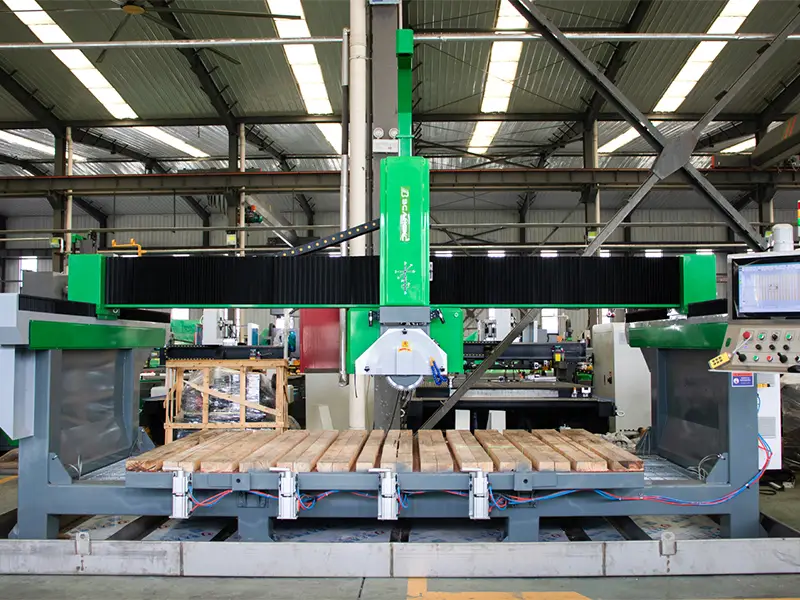
What Is a 5 Axis CNC Bridge Saw?
A 5 axis CNC bridge saw is an automated stone processing machine that controls movement along three linear axes and two rotational axes.
The three linear axes control the movement of the cutting unit across the stone slab:
- The X axis moves the cutting unit from left to right.
- The Y axis moves it forward and backward.
- The Z axis controls vertical movement and cutting depth.
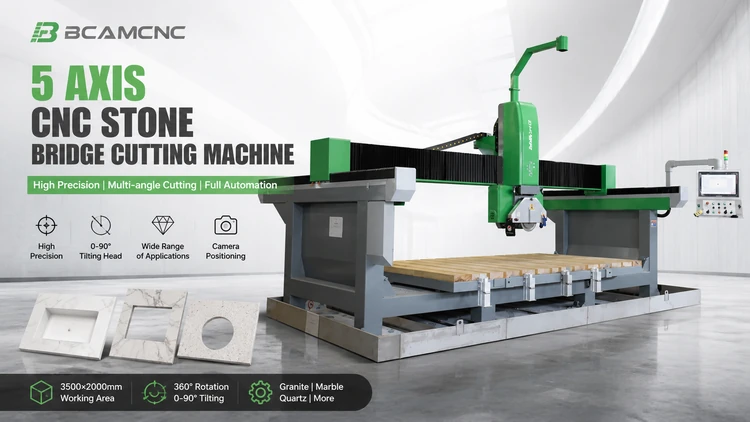
The two rotational axes control the direction and angle of the cutting head. On the BCAMCNC BCMS2035, the published standard specification includes 360-degree head rotation and automatic tilting from 0 to 90 degrees. This allows the blade to approach the material from different directions without requiring the operator to repeatedly rotate the slab manually.
The bridge-style structure supports the cutting assembly above the worktable, providing a stable platform for processing large granite, marble, quartz and engineered-stone slabs.
What Can a 5 Axis CNC Bridge Saw Produce?
The main advantage of five-axis control is not simply adding more movement. It allows several stone processing steps to be completed in one coordinated workflow.
Straight slab cutting
The machine can cut large stone slabs into countertop blanks, wall panels, vanity tops, stair components and other rectangular parts. CNC programming helps maintain consistent dimensions across repeated orders.
Cuts at different angles
Because the cutting head can rotate and tilt, the machine can complete diagonal cuts and customized angled cuts without manually changing the slab position for every operation.
This is useful for architectural elements, irregular countertop layouts and projects that require several cutting directions on one piece.
45-degree miter cutting
A 45-degree miter is commonly used to create thicker-looking countertop edges, waterfall islands, boxed stone structures and seamless corner joints.
A five-axis bridge saw can automatically position the blade for miter cutting, helping the fabricator maintain a more consistent angle along long workpieces.
Sink and stove cutouts
Kitchen countertops frequently require openings for sinks, faucets and cooking appliances. A 5 axis stone bridge saw can process rectangular, oval, curved or customized openings according to the programmed design, depending on the available blade and tooling configuration.
The BCAMCNC machine integrates cutting, chamfering and drilling capabilities for countertop and sanitary-ware applications.
Curved and irregular shapes
Five-axis movement makes it possible to follow arcs, curves and non-rectangular profiles more efficiently than a conventional fixed-head bridge saw.
Common examples include curved countertops, reception desks, decorative stone panels, fireplace surrounds and customized commercial interiors.
Grooving and drilling
With suitable tooling and programming, the machine can produce drainage grooves, positioning holes, faucet holes and other functional features required in kitchen, bathroom and architectural stone products.
The exact processing capability depends on the selected tooling, stone hardness, slab thickness and machine configuration.
Which Materials Can Be Cut?
A 5 axis CNC bridge saw can be configured for both natural and engineered stone materials.
Common materials include:
- Granite
- Marble
- Quartz stone
- Artificial stone
- Engineered stone
- Rock slabs
- Other compatible stone panels
BCAMCNC lists granite, marble, quartz, artificial stone and rock slabs among the main materials supported by the BCMS2035.
However, these materials do not have identical cutting characteristics.
Granite is hard and abrasive, while marble is softer and more sensitive to edge damage. Quartz and engineered stone may require different blade specifications, feed rates and cooling conditions.
Before production begins, operators should select the blade, spindle speed, cutting depth, feed rate and water-cooling volume according to the actual material. Test cutting is recommended when processing a new slab type or supplier batch.
Why Use Five-Axis Cutting for Countertop Production?
Countertop production usually involves more than cutting a slab into a rectangle. A completed project may require sink openings, faucet holes, stove openings, diagonal corners, edge miters and installation notches.
When these operations are performed with several separate machines, the stone must be moved and repositioned multiple times. Each additional setup can increase processing time and introduce alignment errors.
A five-axis CNC bridge saw can combine several operations in one programmed process.
Fewer manual setups
Automatic head movement reduces the need to rotate or realign heavy slabs for every cutting direction.
More consistent dimensions
CNC control follows programmed coordinates, helping maintain consistent part sizes across repeated countertop orders.
Greater design flexibility
The operator can process rectangular countertops as well as curved islands, angled walls, irregular vanity tops and other customized designs.
Reduced dependence on manual cutting
Automation allows more of the main cutting process to be completed by the machine. Manual edge finishing may still be required depending on the desired surface quality and tooling, but the amount of manual measuring and rough cutting can be reduced.
Better use of slab material
A camera-assisted positioning and nesting system can help operators place cutting patterns according to the actual slab location. This is particularly useful when working with expensive natural stone or slabs containing visible veins and defects.
The BCMS2035 product page lists camera positioning, nesting assistance and infrared laser positioning among its available functions.
Five-Axis Bridge Saw vs. Traditional Bridge Saw
Both machine types can be suitable for stone fabrication, but they serve different production requirements.
| Comparison | Traditional Bridge Saw | 5 Axis CNC Bridge Saw |
|---|---|---|
| Straight cutting | Suitable | Suitable |
| Automatic multi-angle cutting | Limited by machine design | Greater angle flexibility |
| 45-degree miter cutting | Manual or configuration-dependent | Programmable |
| Curved profiles | Limited | Suitable for more complex shapes |
| Slab repositioning | More frequent | Reduced |
| CNC nesting | Often limited or optional | Commonly integrated |
| Best suited for | Basic slab sizing | Countertops and customized stone projects |
| Operator requirements | More manual measuring | More programming and software knowledge |
A traditional bridge saw may be sufficient for a workshop that mainly produces rectangular slabs and standard straight cuts.
A 5 axis CNC bridge saw is more suitable when a company frequently receives customized countertop, miter, sink opening and architectural stone orders. The additional flexibility can help the workshop keep more complex processes in-house instead of outsourcing them.
Important Features to Check Before Buying
Not every five-axis stone cutting machine has the same construction, software or processing ability. Buyers should evaluate the complete configuration rather than comparing only the number of axes.
Working area
The table must accommodate the largest slab normally processed by the factory. Consider both current orders and potential future demand.
The published working table of the BCAMCNC BCMS2035 is 3500 × 2000 mm, with an XYZ working range of 3500 × 2000 × 400 mm.
Maximum cutting thickness
The required cutting depth depends on whether the factory processes standard countertops, thick architectural stone, monuments or specialized components.
The BCMS2035 standard specification lists a maximum cutting thickness of 80 mm. Buyers should confirm the recommended thickness for their specific material before ordering.
Cutting-head movement
Check the available rotation and tilt ranges. Full rotation and programmable tilting provide more flexibility for miters, diagonal cuts and complex shapes.
Control system and software
The control interface should support the file formats and programming methods used by the factory. Important considerations include CAD compatibility, G-code support, manual operation and the ease of editing cutting paths.
The BCMS2035 supports CAD and manual programming methods and uses G-code commands according to its published specification.
Camera and laser positioning
A camera can assist with slab positioning, pattern layout and nesting. A laser line helps the operator confirm the cutting location before starting the program.
These functions are particularly valuable when processing natural stone with veins, cracks or areas that must be avoided.
Machine structure
Stone cutting generates substantial cutting forces. A heavy machine frame, stable bridge structure and reliable transmission system help reduce vibration during processing.
The published total weight of the BCMS2035 is approximately 4,200 kg. Its X and Y axes use gear transmission, while the Z axis uses a ball-screw transmission.
Lubrication and maintenance
An automatic lubrication system helps deliver lubricant to moving components at regular intervals. Operators must still inspect guideways, transmission components, electrical cabinets, water lines and cutting tools according to the maintenance schedule.
Technical support and spare parts
Software setup, operator training and after-sales support are important considerations for a five-axis machine. Buyers should confirm installation arrangements, remote diagnostics, training materials, warranty terms and spare-part availability before placing an order.
BCAMCNC BCMS2035 Main Specifications
The BCMS2035 is designed for stone factories producing countertops, vanity tops, architectural panels and customized stone components.
Its published standard configuration includes:
| Parameter | BCMS2035 Standard Specification |
|---|---|
| Working area | 3500 × 2000 × 400 mm |
| Worktable size | 3500 × 2000 mm |
| Rotational axis | 360-degree rotation |
| Tilting axis | Automatic 0–90-degree movement |
| Maximum cutting thickness | 80 mm |
| Maximum rapid travel speed | 30 m/min |
| Programming | CAD and manual programming |
| Command language | G-code |
| Control interface | 15-inch HD touchscreen |
| Positioning assistance | Camera and infrared laser |
| Lubrication | Automatic oil pump |
| Machine weight | Approximately 4,200 kg |
These specifications describe the standard information currently published for the machine. Final motor power, blade configuration, electrical standard, software package and optional functions should be confirmed according to the buyer’s material and production requirements.
Typical Applications
A five-axis stone bridge saw can serve several areas of stone fabrication.
Kitchen countertop production
It can process countertop blanks, sink openings, stove openings, diagonal corners, backsplash components and 45-degree miter edges.
Bathroom vanity production
The machine can produce vanity tops, basin cutouts, faucet holes and customized bathroom stone components.
Waterfall islands and mitered edges
Automatic angled cutting helps prepare miter joints used to create thick visual edges and continuous waterfall-style kitchen islands.
Architectural stone
Possible products include wall panels, flooring components, window surrounds, stair elements, fireplace surrounds and decorative building components.
Commercial interior projects
Stone reception desks, bar counters, display counters and customized retail fixtures often require irregular profiles and several cutting angles.
Monuments and customized stone products
The machine can also be used for blank cutting, angled edges, grooves and shaped components used in memorial and decorative stone production.
How to Request an Accurate Machine Quotation
The most suitable configuration depends on the actual production requirements. A buyer should provide more than a general request for a “stone cutting machine.”
For a more accurate recommendation, prepare the following information:
- The main materials, such as granite, marble or quartz.
- The minimum and maximum slab thickness.
- The largest slab dimensions.
- The products being manufactured.
- Whether sink and stove cutouts are required.
- Whether 45-degree or customized-angle cutting is needed.
- Expected daily production volume.
- Required electrical voltage and frequency.
- CAD or drawing file formats currently used.
- Requirements for cameras, nesting software, drilling or other optional functions.
Providing these details helps the manufacturer recommend the correct blade, motor, control system, working area and software configuration.
Frequently Asked Questions
Can a 5 axis CNC bridge saw cut granite?
Yes. With a suitable diamond blade, cooling system and cutting parameters, the machine can process granite slabs for countertops, wall panels, flooring and other stone products.
Can it cut marble and quartz?
Yes. Marble, quartz, artificial stone and other compatible stone materials are among the main applications of the BCMS2035. Blade selection and cutting parameters should be adjusted for each material.
Can the machine make sink cutouts?
Yes. It can process sink and stove openings according to programmed designs. The possible shape, corner radius and finishing result depend on the blade, additional tooling and selected machine configuration.
Can it cut a 45-degree miter edge?
Yes. The programmable tilting head allows the machine to perform 45-degree cuts for countertop edges, waterfall islands and stone corner joints.
Does a five-axis bridge saw completely replace manual finishing?
Not in every application. It can reduce manual measuring, slab repositioning and rough cutting, but edge polishing or detailed finishing may still be necessary depending on the required surface quality.
Is a 5 axis bridge saw suitable for a small stone workshop?
It can be suitable when the workshop regularly produces customized countertops or wants to reduce outsourcing. A company processing only basic rectangular slabs should compare the expected workload with the investment and operator-training requirements.
What information is needed before choosing a machine?
The manufacturer needs to know the stone material, slab size, thickness, desired products, required cutting operations, production volume, voltage and software requirements.
Is a 5 Axis CNC Bridge Saw Right for Your Factory?
A 5 axis CNC bridge saw is most valuable when a stone factory needs to process more than standard straight cuts.
For countertop manufacturers, it can combine slab sizing, angled cutting, miter preparation, drilling and shaped cutouts in a more coordinated workflow. For architectural and commercial stone companies, five-axis movement provides greater freedom for irregular profiles and customized designs.
The BCAMCNC BCMS2035 offers a 3500 × 2000 mm table, programmable head rotation and tilting, camera-assisted positioning, laser alignment and CNC control for granite, marble, quartz and engineered-stone processing.
To select the correct configuration, provide your slab dimensions, material, thickness and finished-product drawings. BCAMCNC can then recommend a suitable cutting system based on your actual production needs.