
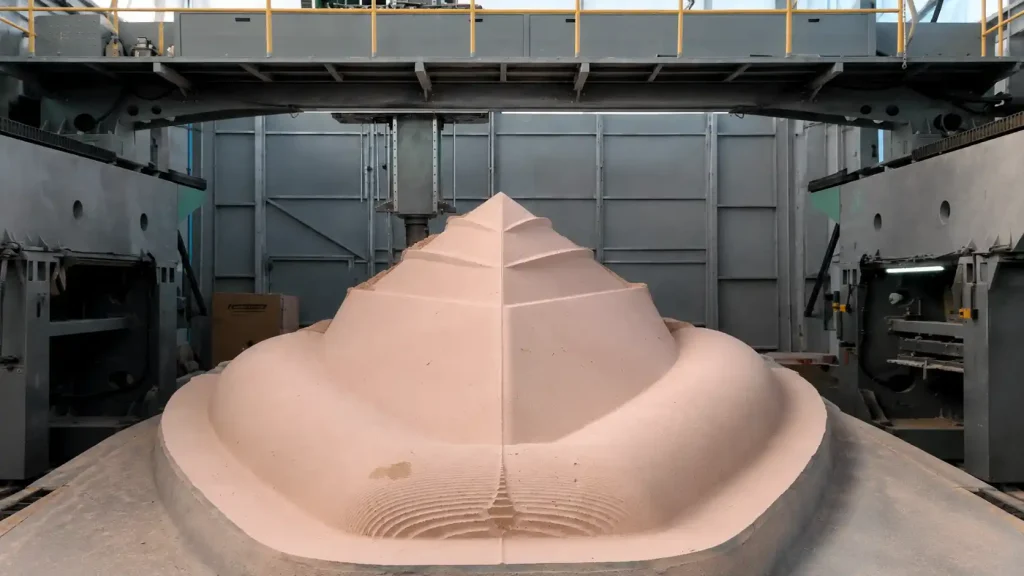
Large molds used in boatbuilding, automotive manufacturing, wind energy, and composite production can exceed the working dimensions of a single CNC machine. In these situations, machining the entire mold as one piece may not be practical.
A common solution is to divide the digital model into smaller sections and machine them separately using a large-format 5 axis CNC router.
However, sectional machining involves more than simply cutting a large model into smaller pieces. Proper planning, accurate positioning, and careful assembly are essential to achieving the intended final shape.
1. Why Are Large Molds Machined in Sections?
Large industrial molds often have considerable length, width, and depth. Even when a suitable CNC router is available, material handling, transportation, and workpiece positioning can make single-piece machining challenging.
Dividing a mold into sections offers several practical advantages.
More flexible machining: Smaller sections can be easier to position and machine within the available working area.
Simplified material handling: Large foam blocks and tooling materials can be difficult to transport and secure as a single workpiece.
Flexible production planning: Different sections can be prepared and machined according to the overall project schedule.
Easier transportation and assembly: For certain oversized projects, manufacturing and transporting individual sections may be more practical than handling one complete mold.
The decision to use sectional machining depends on the mold dimensions, machine capacity, material, and final assembly requirements.
2. Plan the Section Layout Before Machining
The first important step is determining where the large mold should be divided.
This decision should be made during the CAD and CAM preparation stage rather than after machining has started.
The section layout should consider:
- Overall mold geometry and dimensions
- Available CNC working area
- Material block dimensions
- Assembly and positioning requirements
- Areas where joints will be less difficult to finish
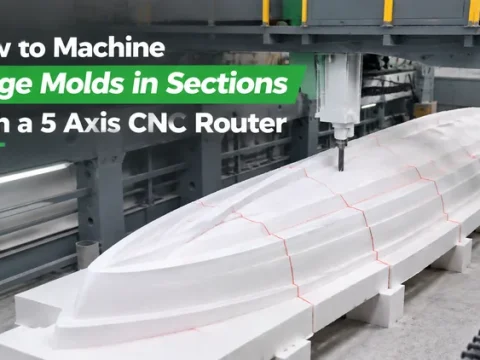
For example, a large boat hull pattern may be divided into several longitudinal sections or other suitable segments depending on its geometry and production setup.
The objective is to create manageable sections without introducing unnecessary joints or making final alignment difficult.
3. Use Consistent Reference Points for Accurate Alignment
One of the biggest challenges in sectional mold machining is ensuring that individual sections fit together correctly.
Even small positioning differences can create steps, gaps, or surface inconsistencies after assembly.
To reduce these problems, manufacturers should establish consistent reference points and positioning methods before machining.
Reference positioning: Use defined datum surfaces or reference coordinates to maintain the relationship between sections.
Assembly features: Depending on the project, locating features or alignment fixtures can help position adjacent sections.
Consistent CAD/CAM coordinates: Each section should follow the same overall model reference system to avoid unnecessary coordinate inconsistencies.
The specific alignment method depends on the mold design, material, and required assembly accuracy.
4. Machine Each Section with a Suitable 5 Axis CNC Router
Once the model has been divided and the machining strategy established, each section can be processed individually.
A 5 axis CNC router offers flexibility when machining complex curved surfaces, inclined areas, and deep sections.
Unlike a fixed vertical cutting direction, five-axis movement allows the tool orientation to change along the programmed machining path.
This is particularly useful for large molds with complicated three-dimensional geometry.
During machining, manufacturers should consider:
Tool accessibility: Ensure the spindle head and cutting tool can reach the required surfaces without interference.
Working dimensions: Confirm that each section fits within the machine’s effective machining envelope.
Cutting strategy: Select suitable roughing and finishing operations according to the material and required surface quality.
Workpiece stability: Make sure each section is securely supported and positioned throughout machining.
For large foam molds, an appropriate machining strategy can help maintain consistent geometry across individual sections.
5. Assemble the Machined Sections
After machining, the individual sections must be positioned and joined to recreate the complete mold.
The assembly process is just as important as the machining itself.
Before joining the sections, manufacturers should inspect their reference surfaces, dimensions, and alignment features.
Depending on the material and application, bonding, mechanical positioning, or other suitable joining methods may be used.
Once assembled, the joints may require additional finishing to create a continuous surface.
For applications such as boat hull patterns and composite tooling, this stage is particularly important because the assembled surface may become the basis for subsequent mold production.
6. Check the Final Surface and Geometry
After assembly, the complete mold should be inspected to identify any differences between adjacent sections.
Particular attention should be given to:
- Surface transitions between sections
- Gaps or steps along joining lines
- Overall dimensional consistency
- Curved surface continuity
- Areas requiring additional sanding or finishing
The inspection method should match the accuracy requirements of the project.
For large molds, a suitable combination of dimensional checks, reference measurements, and surface inspection can help identify issues before the next manufacturing stage.
7. Choosing the Right 5 Axis CNC Router for Large Mold Projects
Not every five-axis CNC router is suitable for oversized mold manufacturing.
When selecting a machine, manufacturers should consider the dimensions of the complete mold as well as the size of each individual section.
Important factors include:
Working area: The machine must accommodate the planned section dimensions.
Z-axis travel and tool clearance: Deep molds and tall workpieces require sufficient clearance for the spindle head and cutting tools.
Machine rigidity: A stable structure supports consistent machining under the intended cutting conditions.
Spindle and tool configuration: These should match the material and machining operations.
Control system and CAM compatibility: The machine should support the required five-axis machining strategy and coordinate management.
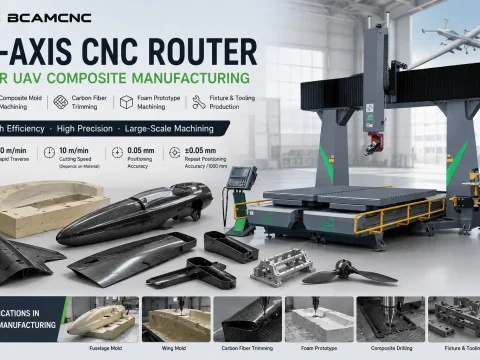
BCAMCNC offers different five-axis CNC router configurations for industrial applications.
The DL Series is positioned for large-format machining, deep cavities, and oversized mold projects where working dimensions and tool accessibility are important.
For boat hull patterns, automotive molds, and large composite tooling, machine configuration should be selected according to the actual workpiece dimensions and production requirements.
Frequently Asked Questions
Can a 5 axis CNC router machine a mold larger than its working area?
Yes, sectional machining is one possible approach. The digital model can be divided into smaller sections that fit within the machine’s effective working dimensions. Accurate reference positioning and assembly are essential.
How do you ensure that different mold sections fit together?
Consistent CAD/CAM coordinates, defined reference points, suitable positioning features, and dimensional inspection help maintain alignment during assembly.
Is machining a large mold in sections always better?
No. Sectional machining introduces additional joints, assembly work, and finishing requirements. If the complete workpiece fits within the machine and can be handled safely, single-piece machining may be more practical.
Can foam mold sections be joined after CNC machining?
Yes. Suitable bonding and positioning methods can be used depending on the foam material, mold design, and subsequent manufacturing process. The joining surfaces should be prepared and inspected carefully.
What industries use sectional CNC mold machining?
Common applications include boatbuilding, automotive prototyping, wind turbine blade tooling, aerospace composite tooling, and large industrial mold manufacturing.
Final Thoughts
Machining large molds in sections allows manufacturers to handle workpieces that may exceed the practical capacity of a single machining setup.
However, successful sectional machining depends on more than dividing a CAD model. Section planning, consistent positioning, suitable five-axis machining, and careful assembly all contribute to the final result.
For large boat hull patterns, automotive molds, and composite tooling, choosing an appropriately configured 5 axis CNC router is an important part of the overall manufacturing process.
Planning a large mold machining project? Contact BCAMCNC to discuss your workpiece dimensions, materials, and five-axis machining requirements.