In furniture manufacturing, edge banding quality is often the difference between a finished product that looks professional and one that requires additional repair work.
Many factories focus on CNC cutting accuracy and panel processing speed, but the edge finishing process determines the final appearance, durability, and production efficiency of furniture panels.
Choosing an edge banding machine is not only about selecting a machine with more functions. The right configuration depends on your production volume, panel quality requirements, edge material, and workflow.
A small workshop producing customized furniture may only need a basic edge bander, while a high-volume cabinet factory may require pre-milling, double trimming, tracking systems, and more automated functions.
Understanding the different types of edge banding machines helps manufacturers choose a solution that matches their real production needs.
Why Edge Banding Is Critical in Furniture Production
Edge banding is an important process in panel furniture manufacturing.
After CNC cutting or panel sizing, the exposed edges of MDF, particle board, plywood, or other panels need to be covered with edge tape to improve appearance and protect the panel structure.
A stable edge banding process helps achieve:
- Better visual quality
- Improved edge durability
- Reduced manual finishing work
- More consistent production results
However, edge banding problems are common in real factories.
Typical issues include:
- Visible glue lines
- Edge tape separation
- Uneven trimming
- Rough finishing
- Damaged panel surfaces
These problems are often related to the combination of machine configuration, material quality, adhesive selection, and operator experience.
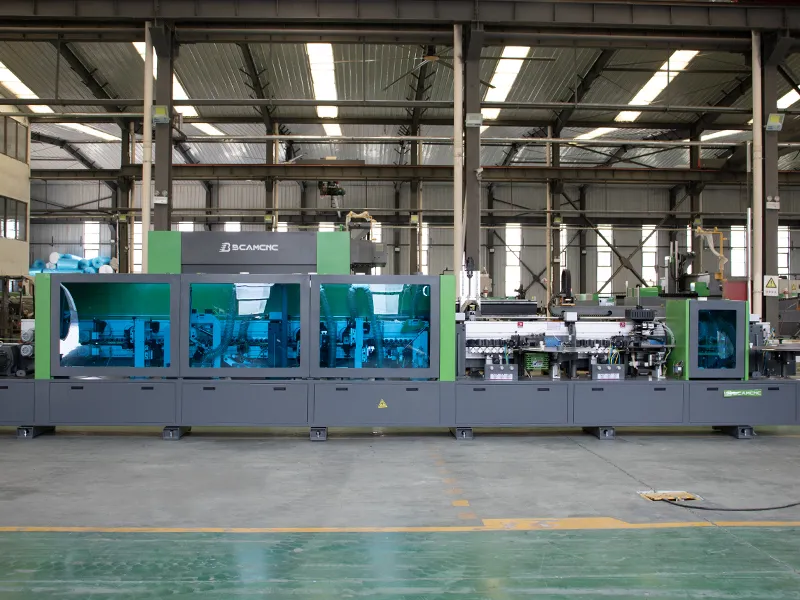
5 Main Types of Edge Banding Machines
Different edge banding machines are designed for different production requirements.
The main categories include:
| Type | Main Functions | Suitable Production |
|---|---|---|
| Basic Edge Banding Machine | Gluing, pressing, trimming, scraping, polishing | Small workshops and standard furniture production |
| Edge Banding Machine with Pre-Milling | Pre-milling + edge banding process | Higher quality furniture production |
| Double Repair Edge Banding Machine | Rough trimming and fine trimming | Medium and large furniture factories |
| Edge Banding Machine with Tracking System | Contour tracking for shaped panels | Complex panel processing |
| Fully Automatic Edge Banding Machine | Multiple functions and higher automation | High-volume industrial production |
1. Basic Edge Banding Machine
A basic edge banding machine is designed for standard panel processing.
It usually includes essential functions such as:
Gluing
The machine applies adhesive between the panel edge and edge tape.
Pressing
Pressure rollers ensure the edge tape bonds properly with the panel.
Trimming and Finishing
The machine removes excess edge material and improves the final appearance.
This type of machine is suitable for:
- Small furniture workshops
- Cabinet manufacturers with standard panels
- Businesses upgrading from manual edge banding
For factories with moderate production requirements, a basic edge bander can provide a practical balance between investment and productivity.
2. Edge Banding Machine with Pre-Milling
Pre-milling is one of the most important upgrades for improving edge quality.
During panel cutting, especially with CNC routers or saw cutting equipment, the panel edge may have:
- Small chips
- Uneven surfaces
- Cutting marks
The pre-milling unit removes a small amount of material before edge banding.
Why Pre-Milling Improves Quality
A cleaner bonding surface helps:
- Improve glue adhesion
- Reduce visible glue lines
- Create a smoother finished edge
Pre-milling is commonly selected by manufacturers producing higher-quality furniture, kitchen cabinets, and decorative panels.
3. Double Repair Edge Banding Machine
Double repair systems include both rough trimming and fine trimming processes.
The purpose is to improve edge finishing consistency.
Rough Trimming
Removes excess edge tape quickly after pressing.
Fine Trimming
Creates a smoother final edge with better appearance.
This configuration is suitable for factories where appearance quality and production efficiency are both important.
It is commonly used for:
- Cabinet doors
- Wardrobes
- Office furniture
- Customized furniture production
4. Edge Banding Machine with Tracking System
Traditional edge banding works best on straight panels.
However, modern furniture designs often include:
- Curved panels
- Irregular shapes
- Special designs
A tracking system allows the machine to follow the panel contour during processing.
Advantages of Tracking Technology
It helps improve:
- Processing flexibility
- Edge finishing consistency
- Production capability for complex designs
This type of machine is useful for manufacturers producing customized furniture and special-shaped panels.
5. Fully Automatic Edge Banding Machine
A fully automatic edge banding machine combines multiple functions into one production system.
Depending on configuration, it may include:
- Pre-milling
- Gluing
- Pressing
- Trimming
- Scraping
- Polishing
- Tracking
- Additional finishing systems
The purpose of automation is not simply to increase machine complexity.
The real value is reducing manual intervention and improving production consistency.
For factories with large production volumes, automation can help reduce labor requirements and maintain stable quality.
How to Choose the Right Edge Banding Machine
The best edge banding machine depends on your actual production situation.
Consider Your Production Volume
A workshop producing a few customized orders per day has different requirements from a factory producing hundreds of panels daily.
Higher production volume usually requires:
- More automation
- More processing units
- Higher stability
Consider Panel Quality Requirements
Different furniture markets have different finishing expectations.
For premium furniture, kitchen cabinets, and export production, pre-milling and advanced finishing functions may provide better results.
Consider Your Complete Production Line
An edge banding machine should work together with other equipment:
- CNC router
- Panel saw
- Drilling machine
- Sanding equipment
A balanced production line is often more important than selecting one individual machine with maximum functions.
Common Edge Banding Problems and Solutions
Visible Glue Line
Possible causes:
- Uneven panel edge
- Incorrect glue temperature
- Poor adhesive selection
Solution:
Pre-milling and correct adhesive adjustment can help improve bonding quality.
Edge Tape Separation
Possible causes:
- Insufficient pressure
- Incorrect glue application
- Material compatibility issues
Solution:
Check the complete bonding process rather than only the machine.
Rough Edge After Trimming
Possible causes:
- Tool wear
- Incorrect trimming adjustment
- Edge material differences
Solution:
Regular maintenance and proper parameter adjustment are essential.
Frequently Asked Questions
What is the difference between a basic edge banding machine and an automatic edge bander?
A basic edge banding machine focuses on essential processes such as gluing, pressing, trimming, and polishing. Automatic edge banders usually include more processing units and automation features for higher production efficiency.
Is pre-milling necessary for an edge banding machine?
Not every factory requires pre-milling. It depends on panel quality requirements, cutting quality, and the expected final appearance.
Which edge banding machine is suitable for cabinet production?
Cabinet manufacturers often choose machines with pre-milling, trimming, and polishing functions. The ideal configuration depends on production volume and product quality requirements.
Can one edge banding machine handle different edge materials?
Most machines can process common edge materials, but the suitable configuration depends on edge tape type, thickness, adhesive requirements, and production conditions.
Choosing the Right Edge Banding Solution with BCAMCNC
Edge banding is a key step in achieving consistent furniture quality.
The right machine configuration depends on your production goals, panel materials, finishing requirements, and workflow.
BCAMCNC provides different edge banding machine configurations, from basic edge processing solutions to advanced automatic systems with pre-milling, double trimming, tracking, and multiple finishing functions.
Whether you are producing cabinets, wardrobes, doors, or customized furniture, selecting the right edge banding technology can help improve production stability and reduce unnecessary finishing work.
Contact BCAMCNC to discuss your production requirements and find a suitable edge banding solution for your factory.