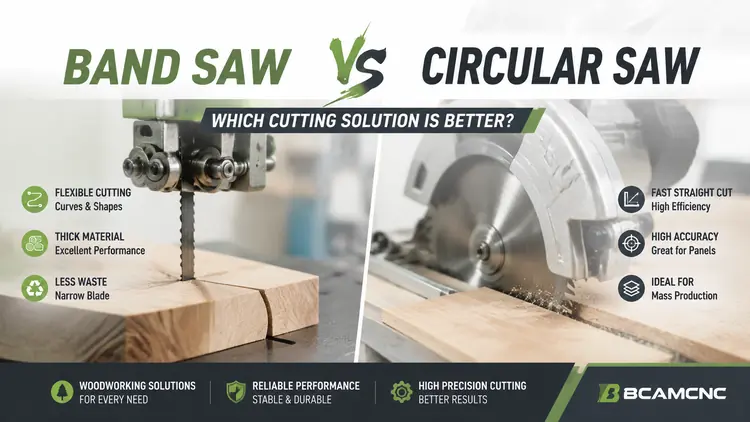
Choosing the right cutting equipment is an important decision for woodworking factories. Both band saw machines and circular saws are widely used in wood processing, but they solve different production problems.
A circular saw is usually preferred for fast straight cutting, while a woodworking band saw provides more flexibility for thick materials, curved cutting, and special-shaped components.
The better choice depends on your production requirements, material type, cutting accuracy, and workflow.
For factories processing solid wood, furniture components, and irregular shapes, a band saw can provide advantages that traditional straight-cutting equipment cannot easily achieve.
How Woodworking Band Saw Machines Work
A woodworking band saw uses a continuous blade running between two wheels to cut through the material.
The blade moves in a continuous loop, allowing the machine to perform different types of cutting operations.
Main Advantages of a Woodworking Band Saw
Flexible Cutting Capability
One of the biggest advantages of a band saw is its ability to cut both straight lines and curved shapes.
This makes it suitable for:
- Solid wood components
- Furniture parts
- Decorative elements
- Custom woodworking projects
Better Performance on Thick Materials
Because of the continuous blade design, band saw machines are often used for thicker wood materials where other cutting methods may have limitations.
Lower Material Waste
The relatively narrow blade reduces cutting loss, which can help improve material utilization when processing valuable wood.
How Circular Saws Work
A circular saw uses a rotating toothed blade to cut material.
It is widely used because of its high cutting speed and ability to produce efficient straight cuts.
Main Advantages of Circular Saws
Fast Straight Cutting
Circular saws are effective for:
- Panel cutting
- Board sizing
- Production lines requiring repeated straight cuts
High Production Efficiency
For standard cutting operations with fixed dimensions, circular saws can provide fast and consistent results.
Suitable for Large Volume Panel Processing
When the production process mainly involves cutting sheets or panels into standard sizes, circular saw equipment can be an efficient solution.
Woodworking Band Saw vs Circular Saw Comparison
| Feature | Woodworking Band Saw | Circular Saw |
|---|---|---|
| Cutting Shape | Straight and curved cutting | Mainly straight cutting |
| Thick Wood Processing | Suitable for thicker materials | Depends on blade size and machine design |
| Material Waste | Lower due to thinner blade | Usually higher cutting kerf |
| Cutting Speed | Moderate | Faster for straight cuts |
| Flexibility | High | Limited |
| Best Application | Solid wood, custom parts, complex shapes | Panels, standard sizing, repeated cuts |
When Should You Choose a Woodworking Band Saw?
A band saw is a better choice when your production requires flexibility.
Solid Wood Processing
Solid wood has natural variations in grain direction, hardness, and thickness.
A band saw allows operators to process different shapes and sizes with greater control.
Custom Furniture Manufacturing
Furniture manufacturers often need unique components that are not limited to simple straight cuts.
Band saw machines are useful for:
- Curved furniture parts
- Decorative wooden components
- Customized designs
Woodworking Shops With Multiple Cutting Requirements
If one machine needs to handle different materials and cutting styles, a band saw provides more versatility.
When Should You Choose a Circular Saw?
A circular saw is usually more suitable when speed and repeated cutting are the main priorities.
Panel Production
For MDF, plywood, and other sheet materials requiring standard dimensions, circular saws can provide efficient processing.
High Volume Straight Cutting
Production environments that require the same cutting operation repeatedly may benefit from circular saw systems.
Common Mistakes When Choosing Wood Cutting Equipment
Many buyers focus only on cutting speed when selecting equipment.
However, the correct choice should consider the complete production process.
Ignoring Material Type
A machine suitable for panel cutting may not be the best option for solid wood components.
Choosing Based Only on Machine Power
Motor power is important, but blade type, machine structure, and application requirements also affect cutting performance.
Not Considering Future Production Needs
A factory may start with simple cutting tasks but later expand into customized furniture or special-shaped components.
Equipment flexibility should be considered during purchase planning.
Frequently Asked Questions
Is a woodworking band saw better than a circular saw?
Neither machine is universally better. A band saw is more flexible for curved cutting and thick materials, while a circular saw is more efficient for fast straight cutting.
Can a band saw cut solid wood?
Yes. Woodworking band saw machines are commonly used for solid wood processing, especially for irregular shapes and thicker materials.
Which machine produces less material waste?
A band saw generally uses a thinner blade, which can reduce cutting loss compared with many circular saw applications.
Should a furniture factory choose a band saw or circular saw?
The choice depends on the production process. Factories focused on customized solid wood components may benefit from a band saw, while factories mainly processing standard panels may prefer circular saw solutions.
Choosing the Right Wood Cutting Solution for Your Production
Band saw machines and circular saws both play important roles in woodworking.
A circular saw is a strong choice for fast, repetitive straight cutting, while a woodworking band saw provides greater flexibility for solid wood processing, curved shapes, and customized components.
Before investing in equipment, manufacturers should evaluate their materials, production volume, and future product requirements.
BCAMCNC provides woodworking machinery solutions designed for different production needs. Contact our team to discuss your application and find a suitable cutting solution for your factory.