For many years, large composite parts have depended heavily on manual finishing. Skilled workers used grinding tools, sanding equipment, and hand correction methods to achieve the final shape and surface quality.
However, as composite components become larger and more complex, this traditional approach is becoming harder to maintain.
The problem is not only labor cost. Manual finishing also creates challenges in consistency, production time, repeatability, and quality control.
For manufacturers producing boat molds, carbon fiber components, fiberglass structures, or large prototypes, 5 axis CNC machining is becoming an effective solution to reduce manual correction and improve production efficiency.
The Hidden Cost of Manual Finishing in Composite Manufacturing
Manual finishing has always played an important role in composite production. Experienced workers can correct small surface imperfections and prepare parts for the next production stage.
However, large composite parts create new challenges.
A typical large composite mold may involve:
- Complex curved surfaces
- Large machining areas
- Tight surface requirements
- Long processing cycles
When most of the finishing work depends on manual labor, manufacturers may face:
Long production time
Large parts require many hours of grinding, sanding, and surface correction.
Quality variation
The final result may depend heavily on operator experience.
Higher labor dependency
Experienced composite finishing workers are valuable but difficult to scale.
More inspection and rework
Small differences between parts can create additional correction work.
For high-volume or high-value composite production, reducing unnecessary manual finishing becomes an important manufacturing goal.
Why 5 Axis CNC Machining Changes Composite Part Production
A 5 axis CNC router allows the cutting tool to approach the workpiece from multiple angles during machining.
Compared with traditional 3 axis machining, 5 axis machining provides advantages when processing:
- Deep cavities
- Complex curves
- Large molds
- Multi-angle surfaces
The machine can maintain a more suitable tool orientation during cutting, which helps improve surface quality and reduce the need for extensive manual finishing.
For composite applications, this is especially valuable because many parts are not simple flat components. They often contain complex aerodynamic or ergonomic surfaces.
Better Surface Quality with Fewer Manual Corrections
One of the biggest reasons manufacturers adopt 5 axis CNC machining is surface consistency.
Manual finishing depends on:
- Worker skill
- Grinding pressure
- Processing experience
- Inspection frequency
A 5 axis CNC router follows programmed tool paths with consistent movement.
This helps manufacturers achieve:
- More uniform surfaces
- More repeatable production
- Reduced polishing requirements
- Better control of final dimensions
For industries such as yacht molds and composite tooling, reducing finishing time can directly affect project delivery schedules.
Composite Materials Require the Right Machining Strategy
Composite materials are different from traditional materials such as steel or aluminum.
Carbon fiber, fiberglass, foam, and tooling boards each have different machining characteristics.
Common challenges include:
- Delamination
- Edge damage
- Dust generation
- Tool wear
- Surface defects
The machine itself is only one part of the solution.
Successful composite machining also depends on:
- Correct cutting tools
- Suitable spindle configuration
- Proper feed rates
- Effective dust collection
- Optimized CAM programming
A 5 axis CNC router provides the flexibility, but the machining strategy determines the final result.
Why Machine Structure Matters for Large Composite Parts
Large composite components often require long machining cycles.
For example, a large mold may run continuously for many hours. During this process, machine stability directly affects machining consistency.
Important factors include:
- Gantry rigidity
- Machine bed stability
- Vibration control
- Long-term accuracy retention
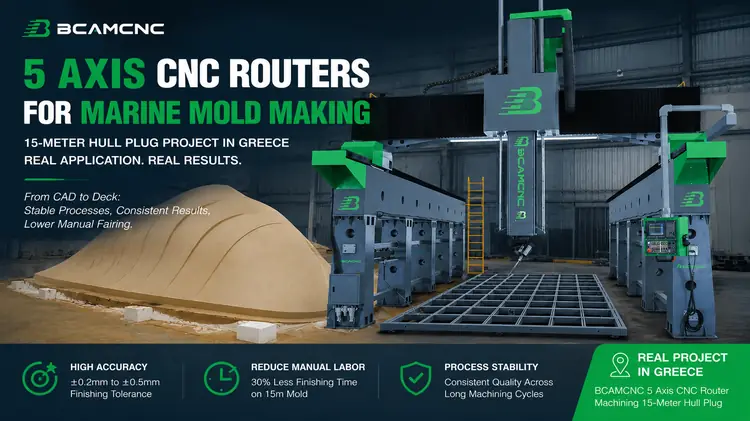
At BCAMCNC, large 5 axis CNC routers are designed for industrial applications where stable performance is essential.
The machine structure uses cast iron components with heat treatment processes to improve stability and support continuous machining of large molds, composite parts, and complex 3D surfaces.
For manufacturers working with large composite components, structural stability is not only about accuracy during the first cut. It is about maintaining reliable performance throughout the entire production process.
Applications of 5 Axis CNC Machining for Composite Industries
5 axis CNC routers are widely used for:
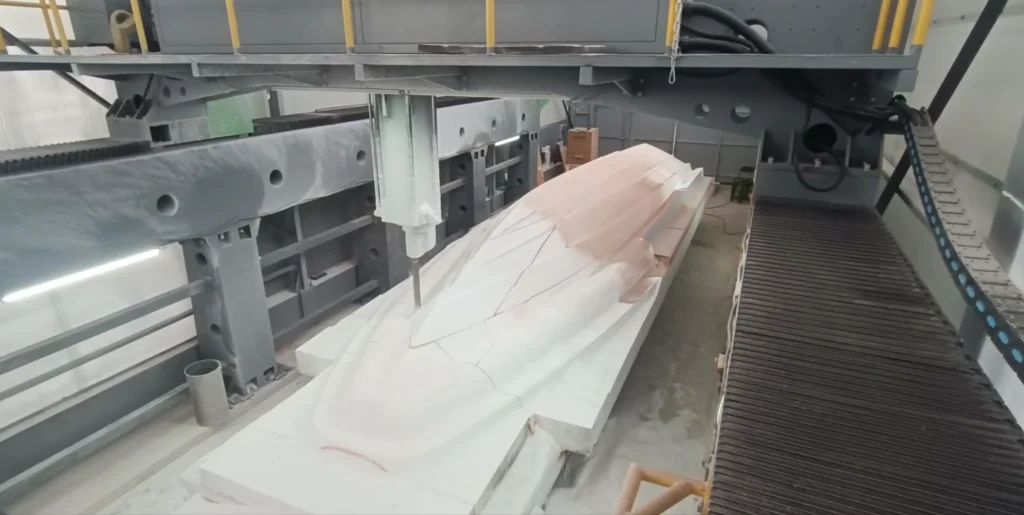
- Boat and Yacht Mold Manufacturing
Large hull molds require smooth curved surfaces and consistent dimensions.
- Carbon Fiber Components
Complex composite structures benefit from accurate multi-angle machining.
- Fiberglass Products
5 axis machining helps produce repeatable molds and patterns.
- Foam Patterns and Tooling Models
Large foam blocks can be efficiently shaped into complex forms.
Choosing Between Manual Finishing and 5 Axis CNC Machining
Manual finishing will continue to have a role in composite manufacturing. Experienced workers remain important for final inspection and specialized corrections.
However, relying on manual processes for the majority of production can limit:
- Output capacity
- Production consistency
- Delivery speed
For manufacturers producing large composite parts, the goal is not to completely replace skilled workers.
The goal is to let CNC technology handle repetitive and demanding machining work while allowing operators to focus on higher-value tasks.
Building More Efficient Composite Manufacturing with BCAMCNC
The transition from manual finishing to 5 axis CNC machining is not simply a machine upgrade. It is a change in the entire production process.
A suitable 5 axis CNC router helps manufacturers reduce manual workload, improve consistency, and handle increasingly complex composite applications.
BCAMCNC provides large-format 5 axis CNC solutions for manufacturers working with molds, composite materials, foam models, and complex 3D components.
By combining stable machine structures, application-focused configurations, and manufacturing experience, BCAMCNC helps customers improve their composite machining workflow.
Frequently Asked Questions
1.Can a 5 axis CNC router completely replace manual finishing?
Not always. Manual finishing is still useful for inspection and special corrections, but 5 axis machining can significantly reduce repetitive finishing work.
2.Why are composite parts difficult to machine?
Composite materials have unique characteristics such as layered structures, different hardness levels, and sensitivity to cutting conditions.
3.What industries use 5 axis CNC routers for composite machining?
Common applications include yacht molds, carbon fiber parts, fiberglass components, aerospace-related tooling, and foam patterns.
4.Is 5 axis machining only suitable for large factories?
Not necessarily. The suitable machine configuration depends on part size, production requirements, and application.