When buyers compare 5 axis CNC routers, accuracy is often one of the first specifications they check.
But positioning accuracy on a specification sheet does not automatically equal the accuracy of the finished part.
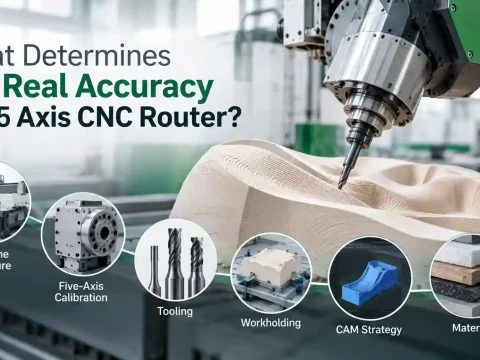
For molds, composite components, foam patterns and complex 3D parts, the final result is influenced by the machine structure, five-axis calibration, tooling, workholding, CAM strategy and the material itself.
Understanding these factors helps manufacturers evaluate a 5 axis CNC router based on real production needs rather than one specification number.
Machine Structure and Rigidity
Accuracy starts with a stable mechanical structure.
During machining, the spindle, gantry and machine frame are continuously affected by cutting forces and changes in direction. Insufficient rigidity can contribute to vibration, which may affect both dimensional consistency and surface quality.
This becomes particularly important for a large 5 axis CNC router, where the machine must maintain stable movement across a larger working area.
What buyers should consider: Machine bed construction, gantry rigidity, structural stability and overall manufacturing quality should be evaluated together with working size and axis travel.
Five-Axis Calibration
A 5 axis CNC router coordinates three linear axes with two rotary axes. This makes calibration more complex than on a conventional 3 axis machine.
Small deviations in the relationship between these axes can affect the actual position and orientation of the cutting tool, especially when machining complex curved surfaces.
Why it matters: Proper calibration helps the machine maintain coordinated motion between linear and rotary axes. Calibration should also be considered part of ongoing machine maintenance, not only initial installation.
Tool Length and Tool Condition
Even when the machine moves accurately, the cutting tool can introduce errors.
Large molds and deep cavities may require longer tools. As tool overhang increases, rigidity can decrease and sensitivity to vibration or deflection may increase.
Worn tools can also affect cutting forces, dimensions and surface finish.
What to check: Tool diameter, tool length, tool condition and cutting parameters should match the material and part geometry.
Workholding and Part Stability
A precise machine cannot produce a precise part if the workpiece moves during machining.
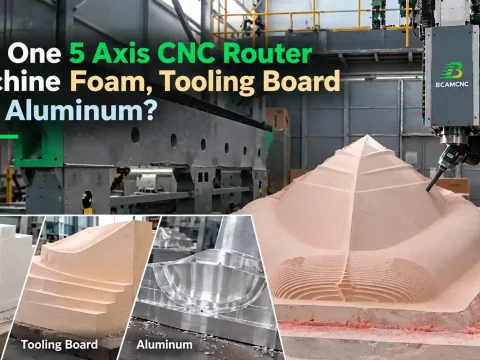
This is particularly relevant when processing large foam molds, tooling board, composite molds and irregular 3D components.
The key point: Workholding should keep the part stable throughout the machining process without interfering with tool access.
For large or irregular parts, fixture design can be just as important as the machine itself.
CAM Programming and Toolpath Strategy
A 5 axis CNC router provides the ability to approach a part from different angles, but the CAM program determines how that capability is used.
Tool orientation, cutting direction, step-over, tool length and rotary-axis movement can all influence the final result.
Poor toolpath planning may lead to unnecessary axis movement, vibration, surface marks or longer machining times.
Machine capability and CAM strategy must work together. A good machine cannot fully compensate for an unsuitable toolpath.
Material Also Affects the Final Result
Not every dimensional problem comes from the CNC machine.
Foam, tooling board, wood and composite materials behave differently during cutting. Material characteristics, clamping conditions and tool selection can all influence the finished component.
When evaluating an accuracy problem, it is therefore important to consider the machine, tool, fixture, program and material as one complete system.
Machine Accuracy Is Not the Same as Part Accuracy
This is the most important distinction for a 5 axis CNC router buyer.
Machine accuracy describes how accurately the machine axes can position and move under specified conditions.
Finished-part accuracy is the result of multiple factors working together:
Machine Structure + Calibration + Tooling + Workholding + CAM Strategy + Material
This is why comparing two 5 axis CNC routers based only on one accuracy specification can be misleading.
How Should You Evaluate a 5 Axis CNC Router?
Instead of asking only, “What is the machine accuracy?”, buyers should also consider:
- Machine structure and rigidity
- Five-axis calibration
- Tool and spindle configuration
- Workholding requirements
- CAM and post-processing compatibility
- Installation and commissioning
- Actual machining results
A practical approach: If possible, use a representative part or material for a machining test. A sample similar to your actual production can provide useful information beyond a specification sheet.
Choosing a 5 Axis CNC Router with BCAMCNC
At BCAMCNC, a 5 axis CNC router configuration should be evaluated according to the actual application.
Part dimensions, material, geometry, working travel, tool requirements and machining process can all influence machine selection.
This is particularly important for large molds and complex 3D components, where machine stability, tool accessibility and long machining cycles need to be considered together.
If you are evaluating a 5 axis CNC router, send BCAMCNC your 3D model or part drawing, material, dimensions and machining requirements. This allows the machine configuration to be discussed around the parts you actually need to produce rather than relying only on specification numbers.
Frequently Asked Questions
Does higher positioning accuracy always mean more accurate finished parts?
Not necessarily. Finished-part accuracy also depends on calibration, tooling, workholding, CAM strategy, material and machining conditions.
Why is calibration important on a 5 axis CNC router?
Five-axis machining requires coordinated movement between linear and rotary axes. Proper calibration helps maintain the correct relationship between these movements.
Can long cutting tools affect accuracy?
Yes. Longer tool overhang can reduce rigidity and increase sensitivity to vibration or deflection, depending on the cutting conditions.
What is the best way to evaluate a 5 axis CNC router?
Review the machine specifications, but also consider the structure, calibration, tooling and actual machining results for parts similar to your application.