When choosing a 5 axis CNC router, buyers usually start with the length and width of the workpiece.
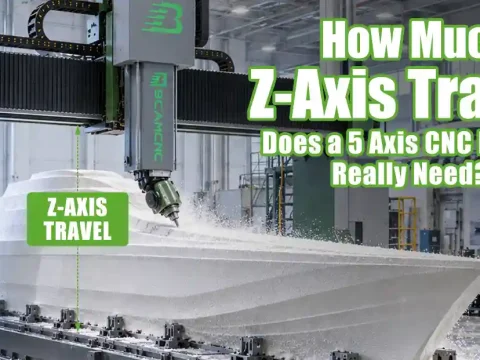
But for large molds, foam patterns and complex 3D parts, there is another dimension that can easily be underestimated: Z-axis travel.
A 500 mm high part does not necessarily mean that 500 mm of Z travel is enough. The machine also needs space for the cutting tool, spindle head, tool orientation and safe movement around the workpiece.
That is why Z-axis travel should be selected according to the complete machining process, not just the height of the part.
Part Height Is Only the Starting Point
Suppose your workpiece fits comfortably within the machine’s X and Y working area.
That does not automatically mean the machine can reach every surface.
In 3-axis machining, the spindle normally approaches the workpiece vertically. On a 5 axis CNC router, the machining head can approach curved surfaces from different orientations.
As the head tilts, it requires additional space around and above the part.
The practical question is therefore not simply:
“How tall is my workpiece?”
It is:
“Can the tool reach all required surfaces while the 5-axis head moves through the necessary angles?”
Why Large Molds Often Need More Z Travel
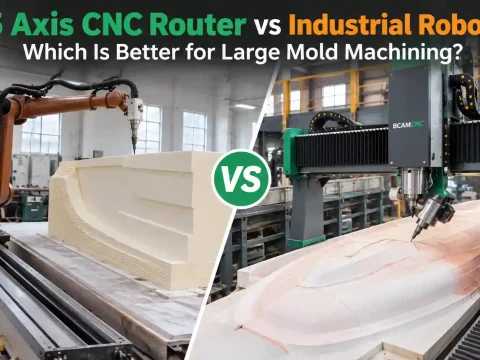
This becomes especially important when machining large 3D parts such as:
- Boat and yacht molds
- EPS foam patterns
- Tooling board molds
- Composite molds
- Automotive prototypes
- Large curved components
These parts may have deep surfaces, tall features or areas that require the cutting head to approach from the side.
A machine may have enough vertical clearance for the workpiece itself but still have insufficient room once the spindle head and cutting tool begin to tilt.
For this reason, large working dimensions alone do not guarantee that a machine is suitable for a large part.
Tool Length Changes the Required Space
Tool length is another factor that buyers sometimes overlook.
Large molds and deep cavities may require longer cutting tools to reach certain areas. But the tool, holder and spindle head all occupy space inside the machine’s working envelope.
Longer tools can improve accessibility, but they also change the clearance required for machining.
Simply increasing tool length is not always the solution either. Excessive tool overhang can reduce rigidity and make the cutting process more sensitive to vibration.
The machine configuration and tooling strategy should therefore be considered together.
Five-Axis Head Movement Needs Clearance
This is where choosing a 5 axis CNC router differs significantly from choosing a conventional 3 axis router.
Imagine a large mold that fits perfectly under the gantry.
When the tool is vertical, everything looks fine.
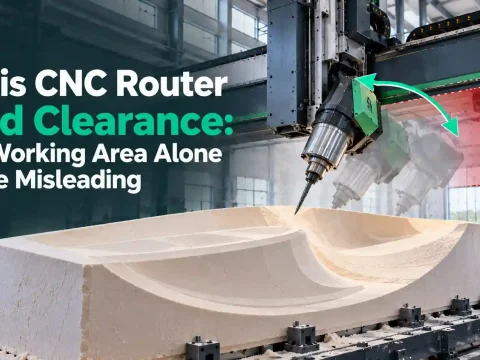
But when the machining head tilts to reach the side of the mold, the spindle body or tool may move closer to the workpiece, fixture or machine structure.
A part that physically fits inside the machine may still be difficult to machine from every required angle.
This is why head clearance and usable machining space can be more meaningful than simply comparing Z-axis numbers between two machines.
More Z Travel Is Not Automatically Better
It can be tempting to choose the largest possible Z-axis travel “just in case.”
But bigger is not automatically better.
A machine should be configured around the parts it will actually produce. Unnecessary travel may increase machine size and affect other aspects of the machine configuration without providing a meaningful production benefit.
A better approach is to look at your typical workpieces first.
Consider:
- Maximum part height
- Typical part height
- Deepest machining area
- Tool length required
- Surfaces requiring angled machining
- Fixture or support height
- Clearance required for 5-axis head movement
The goal is not to buy the largest machine. It is to make sure the available working space matches the real machining task.
Don’t Choose a 5 Axis CNC Router by Table Size Alone
When comparing machines, a large table can be visually impressive.
But table length and width tell only part of the story.
For complex 5 axis machining, buyers should consider the entire usable working envelope:
X/Y Working Area + Z Travel + Gantry Clearance + Tool Length + 5-Axis Head Movement
This is particularly important for large molds and irregular 3D components, where tool accessibility can determine whether the part can actually be completed in the intended setup.
Choosing the Right Configuration with BCAMCNC
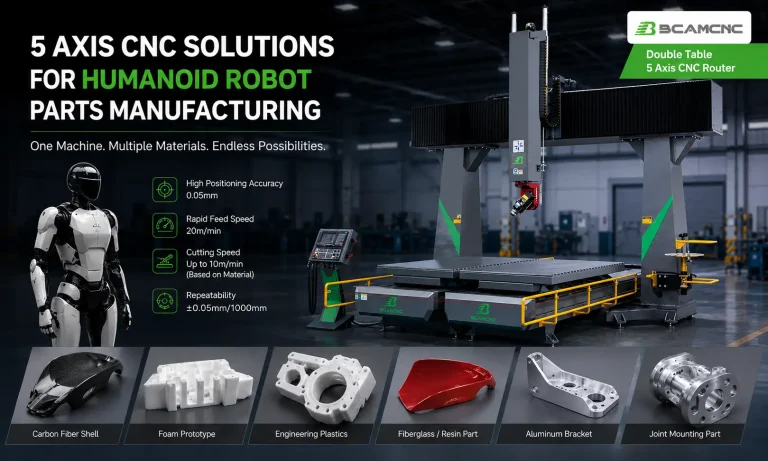
At BCAMCNC, the appropriate 5 axis CNC router configuration should be evaluated according to the actual workpiece rather than selecting Z-axis travel from a specification sheet alone.
For large molds and complex 3D parts, information such as part dimensions, maximum height, material, 3D geometry and required machining surfaces can help determine the working space and machine configuration needed.
If you are unsure how much Z-axis travel your application requires, send BCAMCNC your 3D model or part drawing, material and overall dimensions.
The objective is simple:
Make sure the machine does not only fit the part — it can actually reach the surfaces you need to machine.
Frequently Asked Questions
Is Z-axis travel the same as maximum workpiece height?
No. Tool length, fixtures, spindle-head geometry and required machining angles can all affect the usable space available for the workpiece.
Why does a 5 axis CNC router need more clearance?
Because the machining head can approach the workpiece from different orientations. Tilting the head changes the space required around the tool and workpiece.
Should I always choose the largest Z-axis travel available?
Not necessarily. The appropriate travel should be based on your actual part dimensions, tooling and machining requirements.
What should I provide when asking for a 5 axis CNC router recommendation?
A 3D model or drawing is particularly useful, together with the material, overall dimensions, maximum part height and main machining requirements.