A five-axis bridge saw can shorten setup time and handle cuts that are awkward on a manual saw. That does not mean every five-axis machine will suit every stone shop. The right choice depends on the slabs you process, the finished parts you sell, and how much secondary work your operators can accept.
This sounds obvious, yet many purchase discussions begin with motor power and price before anyone asks to see a typical drawing. On the factory floor, that order is backwards. A shop producing straight granite stair treads has a different requirement from one cutting quartz kitchen tops with mitred edges, sink openings, and irregular islands.
Before comparing machines, collect five things: material names, slab dimensions, thickness range, DXF drawings, and photos of the finished edges. Those details tell an engineer more than a request for a “fully automatic stone machine.”
Start With the Work, Not the Axis Count
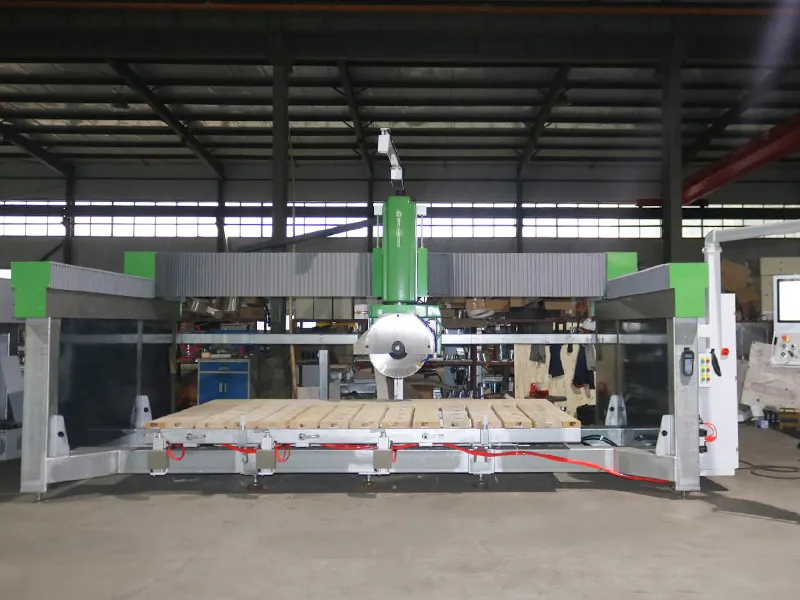
The extra rotary motion on a five-axis CNC bridge saw allows the blade to approach a slab from different directions. It is useful for mitres, bevels, polygonal parts, and layouts that would otherwise require repeated manual positioning.
Still, “five-axis” is not a complete specification. Ask which axes are CNC controlled and whether the machine performs simultaneous interpolation or indexed positioning. The same label can describe different motion arrangements.
The BCAMCNC BCMS2035 uses a 360-degree A-axis and an automatically controlled B-axis from 0 to 90 degrees. Its published standard working area is 3500 × 2000 × 400 mm. Check this against the largest usable slab—not merely its nominal size.
Match the Machine to the Material
Stone is not one material with several colours. Cutting behaviour changes with mineral composition, resin content, thickness, internal stress, and even the direction of the pattern.
| Material | Typical Shop Concern | What to Check During a Cutting Test |
|---|---|---|
| Granite | High cutting load and abrasive wear | Blade specification, feed stability, motor load, cooling-water delivery, and edge breakout |
| Marble | Local chipping, veining, and fragile corners | Entry and exit strategy, slab support, blade condition, and corner handling |
| Engineered quartz | Heat around the cut and silica-containing dust or slurry | Wet-cutting method, blade selection, feed rate, and slurry control |
| Sintered stone or porcelain slab | Brittle edges and chipping, especially on thin panels | Lead-in cuts, support under the slab, reduced acceleration near corners, and a sample made from the buyer’s material |
| Artificial stone | Formulation varies between suppliers | Resin content, blade suitability, heat behaviour, and actual finish quality |
Countertop work often uses slabs around 12, 20, or 30 mm thick, while architectural and monument work may be thicker. The published maximum cutting thickness for the standard BCMS2035 is 80 mm. Maximum capacity is not the same as an ideal production thickness: dense 80 mm granite places a very different load on the blade and motor from 20 mm marble.
Send representative samples for testing when the material is unusual, expensive, or prone to chipping. A clean cut in a generic showroom slab proves very little about your own stock.
Read Power and Speed as a Pair
Motor power is easy to compare, so it attracts too much attention. Usable cutting performance also depends on spindle or saw speed, blade diameter, torque, feed rate, cut depth, cooling, and machine rigidity.
The current BCMS2035 standard specification lists a 7.5 kW, three-phase 380 V/50 Hz main motor with a speed range of 1,000–6,000 rpm. Voltage and frequency may differ by destination and ordered configuration, so approve the final electrical drawing before preparing the supply.
Do not apply one brochure feed rate to every slab. Start with the blade supplier’s recommendation, then adjust through test cuts while watching motor load, sound, edge condition, and chipping.
The standard machine specification gives a maximum rapid travel rate of 30 m/min. That is an axis movement figure, not a promise that stone can be cut at 30 m/min.
Be Precise About Precision
Buyers often ask, “What is the machine accuracy?” The better question is: which accuracy, measured where, over what distance, and under what conditions?
The BCMS2035 parameter table states X/Y/Z travelling positioning accuracy of ±0.8 mm over 2,000 mm. This is not finished-part tolerance. Blade runout, wear, calibration, slab flatness, fixturing, cutting force, and measurement all affect the result.
Before shipment, agree on a test part and measurement plan covering dimensions, mitre angle, diagonals, hole position, and edge condition. ISO 230-2 describes methods for determining the positioning accuracy and repeatability of numerically controlled machine axes. It does not replace a cutting test on the customer’s stone.
BCAMCNC operates an ISO 9001:2015 quality-management system. That supports documented production and inspection processes; it should not be presented as proof that every finished stone part will meet one universal tolerance.
Check Utilities Before the Machine Arrives
Installation problems are rarely glamorous. A machine reaches the customer, then everyone discovers that the door is too low or the floor plan ignores service clearance.
The published overall size of the BCMS2035 is 5800 × 3120 × 3320 mm, with a listed weight of 4,200 kg. Also allow for loading, cabinet clearance, blade changes, drainage, slurry removal, and safe operator movement.
The standard product table does not publish a compressed-air requirement. If the ordered machine includes pneumatic accessories, request the pressure and consumption in writing. Many workshop systems operate around 0.6–0.8 MPa, but that general range is not a substitute for the approved installation sheet.
Wet cutting controls heat and carries debris away, but the slurry needs a collection plan. Do not assume a bridge saw includes a high-pressure waterjet module. If a quotation says “sawjet,” ask for the pump pressure, nozzle system, abrasive feed, and a separate demonstration.
Look Closely at Software and Daily Operation
CAD import is only one part of the workflow. Ask the supplier to demonstrate the path from a customer drawing to a finished cut:
- importing or drawing the part;
- placing it on a photographed or measured slab;
- setting kerf compensation and cutting order;
- defining mitre angles and safe approach moves;
- running a dry simulation;
- recovering after an alarm or interrupted program.
The BCMS2035 supports CAD and manual programming and uses G-code. Listed equipment includes camera nesting, infrared positioning, a touch-screen interface, and automatic lubrication. Confirm what is standard in the quotation and what depends on software or optional hardware.
A useful demonstration includes an imperfect slab and a real drawing. Perfect rectangles hide most decisions an operator faces during custom work.
Know What the Saw Will Not Finish
A five-axis bridge saw is primarily a cutting machine. Depending on its tooling and ordered functions, it may perform slots, holes, chamfers, and some contour work. It does not automatically replace a stone CNC router, edge polisher, or waterjet.
Blade geometry limits the smallest internal radius. Tight sink corners may require corner drilling, relief cuts, or secondary finishing. A sawn edge may still need polishing. Deep hard-stone cuts can require several passes.
The costly mistake is watching a saw cut an outside contour, then expecting it to produce every internal profile with no handwork.
A Field Case: Moving Beyond Repeated Manual Positioning
One overseas stone workshop documented on the BCMS2035 product page had used an older four-axis machine. Its work included custom countertop edges and complex three-dimensional stone designs. After moving to the five-axis bridge saw, it reported better stability and precision than with its previous equipment.
No percentage improvement or production rate was recorded. The useful detail is the job mix: the upgrade was tied to angled countertop work and complex shapes, not ordinary straight cutting. A shop cutting only rectangular blanks may have a weaker business case.
Build the Purchase Specification Around Acceptance
Before ordering, put the following points into the technical agreement:
- working area, usable loading area, Z clearance, and maximum tested thickness;
- axis travel and rotary-angle limits;
- motor power, voltage, frequency, speed range, and electrical load;
- blade sizes and blade-flange details;
- positioning-accuracy and repeatability test methods;
- CAD/CAM formats, nesting, camera functions, and software licence terms;
- water supply, drainage, air pressure if applicable, and foundation;
- safety guarding, interlocks, emergency stops, and destination-market requirements;
- test material, drawings, acceptance dimensions, and permitted defects;
- training, remote support, spare parts, consumables, and warranty scope.
BCAMCNC’s published standard configuration is CE certified, while the company’s quality system is certified to ISO 9001:2015. Review the final machine against the destination country’s safety and electrical requirements. CE marking, ISO certification, and process capability answer different questions.
FAQ
Can a five-axis CNC bridge saw cut granite, marble, and quartz?
Yes, with the correct diamond blade, cooling, feed settings, and support method. Each material behaves differently, so a sample test using the buyer’s slab is more useful than a general material list.
What thickness can the BCMS2035 cut?
The published standard specification lists a maximum cutting thickness of 80 mm. Actual process settings depend on material, blade, cut depth, edge-quality requirement, and ordered configuration.
Is 7.5 kW enough for granite?
The standard specification currently lists a 7.5 kW main motor. Whether it suits a particular granite job depends on thickness, blade diameter, depth per pass, feed rate, and production target. Send BCAMCNC the material and drawing for a cutting test rather than judging by power alone.
Does five-axis control eliminate manual finishing?
Not in every job. Tight internal corners, polished edges, small-radius profiles, and some sink details may still require another tool or a secondary process.
What air pressure does the machine require?
The standard online specification does not state an air-pressure value. Pneumatic demand depends on the ordered accessories. Confirm pressure, flow, air quality, and connection size on the final installation drawing.
How should we verify accuracy before shipment?
Agree on a test drawing, material, thickness, blade, measuring method, and acceptance limits. Measure the finished sample as well as axis positioning. Keep the inspection record with the machine documents.
What information should we send for a quotation?
Provide the material type, maximum slab size, thickness range, required edge and cut types, sample drawings, expected daily workload, workshop voltage, and available floor space. Photos of current finished parts—and the troublesome ones—are particularly helpful.
Choosing a five-axis CNC bridge saw is less about finding the longest feature list and more about removing the right bottleneck. Send BCAMCNC your slab information and two or three representative drawings. Our engineers can review the cutting sequence, confirm the configuration, and arrange a material test before the specification is finalized.