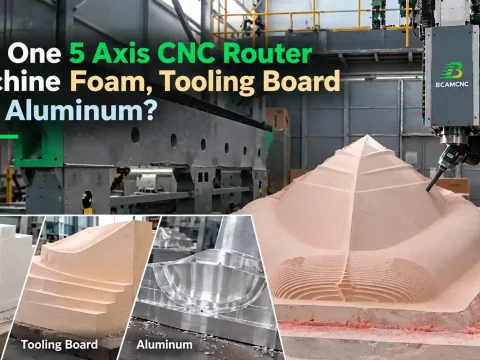
Can the same 5 axis CNC router machine soft EPS foam, high-density tooling board and aluminum?
The short answer is yes, but not every machine is equally suitable for all three materials.
A machine designed for large foam sculptures may work efficiently with lightweight cutting loads, while aluminum mold machining demands greater structural rigidity, suitable spindle performance and carefully selected cutting tools.
Understanding these differences helps manufacturers choose a machine that matches their actual production needs.
Foam, Tooling Board and Aluminum: What’s the Difference?
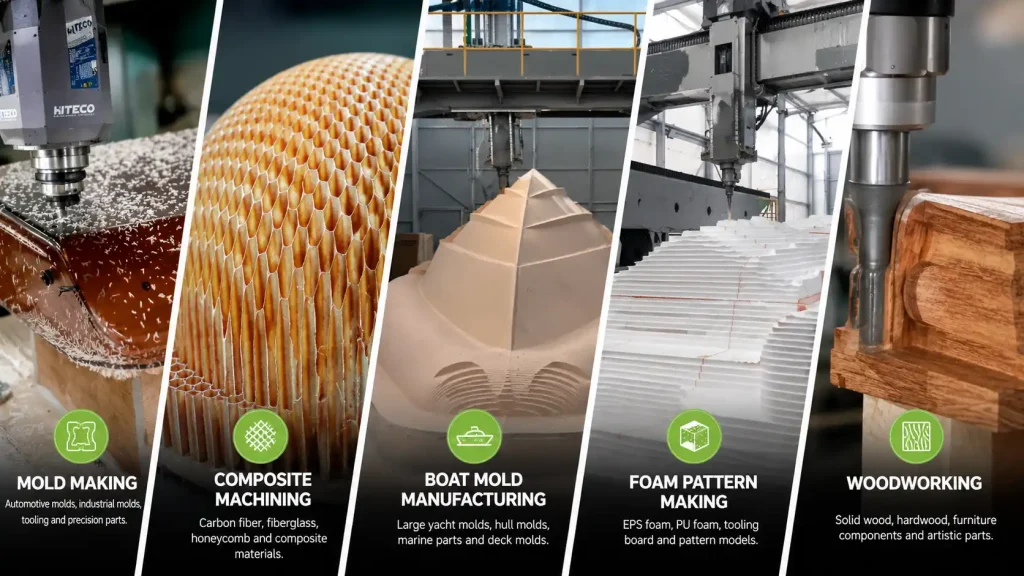
Although all three materials can be processed with five-axis CNC technology, their cutting characteristics are quite different.
EPS Foam: Lightweight and Easy to Shape
EPS foam generates relatively low cutting forces, making it suitable for large molds, yacht patterns, automotive prototypes and 3D sculptures.
For foam machining, working area, Z-axis clearance and efficient material removal are often more important than heavy-duty cutting capacity.
Tooling Board: Greater Density, Greater Demands
Polyurethane and epoxy tooling boards are widely used for composite molds, master patterns and industrial prototypes.
Compared with EPS foam, higher-density tooling boards generally require more cutting force and better control of vibration and surface finish.
Aluminum: Rigidity Becomes Essential
Aluminum machining introduces higher cutting forces, greater heat generation and more demanding chip removal requirements.
A machine that performs well on foam may struggle with aluminum if its frame, spindle and tooling are not designed for these conditions.
Why Machine Rigidity Matters
A five-axis machine must remain stable while its cutting head moves through different angles.
When machining foam, cutting forces are relatively low. For denser tooling boards and aluminum, vibration and structural deflection become more important.
A rigid machine bed, stable gantry and suitable motion system help maintain consistent cutting conditions.
However, a heavier machine is not automatically a better machine. Structural design, manufacturing quality and dynamic stability matter more than weight alone.
This is why machine construction should be evaluated according to the intended material and machining workload.
Spindle and Cutting Tools: One Setup Doesn’t Fit Every Material
Spindle power alone does not determine machining capability.
For Foam: Large cutting tools and suitable spindle speeds can help remove material efficiently while maintaining the desired surface shape.
For Tooling Board: Tool geometry, cutting parameters and spindle stability influence surface quality and tool life.
For Aluminum: Suitable torque, cutting tools, chip evacuation and lubrication or cooling arrangements become particularly important.
Using the wrong tool or cutting parameters can lead to poor surface finish, vibration or unnecessary tool wear.
The best configuration balances machine rigidity, spindle performance and cutting strategy rather than relying on one specification.
Which BCAMCNC 5 Axis CNC Router Series Fits Your Material?
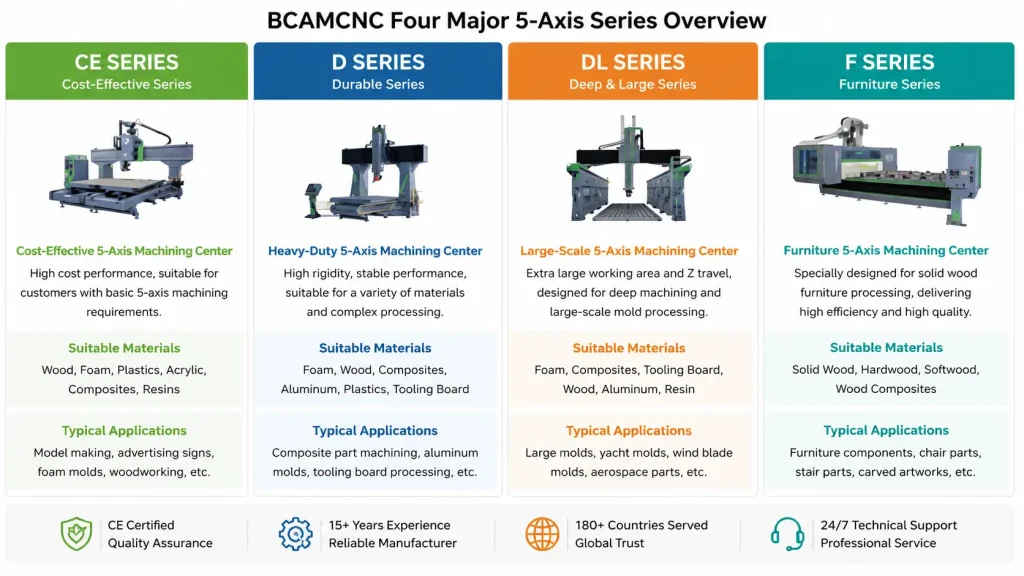
BCAMCNC offers different five-axis configurations for different manufacturing applications.
| Series | Main Positioning | Typical Applications |
|---|---|---|
| DP Series | Lightweight foam machining | Foam patterns and large 3D models |
| CE Series | Cost-effective general machining | Foam, wood, resin and model making |
| D Series | Rigid industrial machining | Tooling board, aluminum and composite molds |
| DL Series | Large-format and deep machining | Yacht molds, wind blade molds and large tooling |
| F Series | Solid wood machining | Curved furniture and irregular wood components |
For large foam molds, the DP Series or a suitably configured large-format machine may be considered, depending on workpiece dimensions.
For tooling board and aluminum, the D Series is a stronger starting point when structural rigidity and controlled cutting performance are priorities.
For oversized molds, the DL Series provides large-format machining options, with the final configuration determined by material, cutting requirements and part dimensions.
The CE and F Series serve different needs, from general five-axis applications to specialized solid-wood furniture manufacturing.
The right choice depends on more than material alone.
Can You Use One Machine for Multiple Materials?
For manufacturers processing foam, tooling board and occasional aluminum components, a suitably configured industrial five-axis machine may handle all three.
However, there is an important distinction between being able to cut a material and being optimized for continuous production.
A machine primarily used for foam may not justify the cost of a heavier configuration. Conversely, a factory regularly machining aluminum should not select a lightweight machine simply because it offers the required working dimensions.
Before purchasing, consider:
- Your primary material and how often it changes
- Maximum workpiece dimensions and height
- Required surface finish and dimensional tolerance
- Cutting tools, spindle configuration and production volume
These factors help determine whether a versatile machine or a more specialized solution is the better investment.
Find the Right 5 Axis CNC Router with BCAMCNC
BCAMCNC provides five-axis CNC solutions for foam patterns, tooling board, composite molds, aluminum components and solid-wood applications.
Rather than choosing a machine based only on spindle power or working area, manufacturers should evaluate the complete machining process.
Whether you are producing large yacht molds or smaller aluminum tooling components, BCAMCNC can help evaluate a suitable machine series and configuration.
Share your material, 3D model, workpiece dimensions and production requirements to discuss the right 5 axis CNC router for your project.
Frequently Asked Questions
Can a foam CNC router machine aluminum?
Not necessarily. Aluminum machining requires suitable rigidity, spindle performance, tooling and chip management. A lightweight foam-focused machine may not be appropriate.
What is the best 5 axis CNC router for tooling board?
A rigid industrial configuration, such as the BCAMCNC D Series, is worth considering. The final choice depends on tooling board density, part size and accuracy requirements.
Do I need a heavy-duty 5 axis CNC router for EPS foam?
Not always. For foam machining, working dimensions, head accessibility and efficient cutting may be more important than maximum structural rigidity.
Can one 5 axis CNC router process both tooling board and aluminum?
Yes, with an appropriate machine configuration and material-specific cutting tools and parameters.