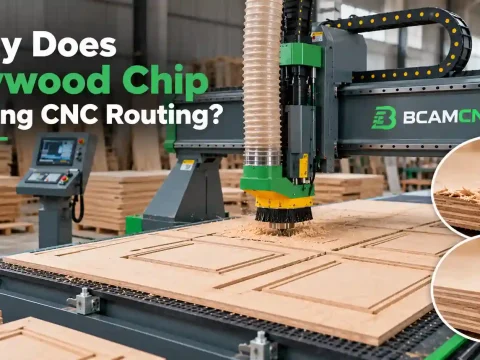

Plywood is widely used in furniture manufacturing, cabinet production, interior decoration, and custom woodworking. Its layered structure provides strength and versatility, but it also creates challenges during CNC routing.
One common problem is edge chipping, where the surface veneer breaks or splinters along the cutting path. This can leave rough edges, damage decorative surfaces, and increase the amount of sanding or rework required.
For woodworking businesses, poor plywood cutting quality means more than an unattractive edge. It can lead to wasted panels, longer production times, and inconsistent finished products.
Understanding why plywood chips during CNC routing is the first step toward achieving cleaner, more reliable cuts.
1. Why Is Plywood More Prone to Chipping?
Unlike solid wood, plywood consists of multiple thin wood veneers bonded together with adhesive. The grain direction generally alternates between adjacent layers.
This construction makes plywood dimensionally stable, but the cutting tool must pass through wood fibers with different orientations.
When a CNC router bit enters or exits the material, its cutting forces can lift or tear fibers from the surface veneer.
Chipping is especially noticeable when processing decorative plywood, thin face veneers, or panels with brittle surface layers.
Common signs of plywood cutting problems include:
- Splintering along the top edge
- Tear-out on the bottom surface
- Rough or fuzzy edges
- Damaged veneer near corners
- Uneven cutting quality along the same panel
These problems may have different causes, so identifying where the damage occurs is important before changing machining parameters.
2. Using the Wrong CNC Router Bit
Tool selection is one of the most important factors affecting plywood edge quality.
Different router bits produce different cutting forces and chip-removal directions.
Upcut Spiral Router Bits
Upcut bits pull chips upward and provide effective chip evacuation.
However, their upward cutting action can lift fibers from the top veneer, increasing the risk of surface chipping.
They may be useful when chip removal is a priority, but they are not always the best choice for decorative top surfaces.
Downcut Spiral Router Bits
Downcut bits direct cutting forces toward the workpiece surface, helping protect the top veneer.
They are often suitable for shallow cuts, grooves, and operations where the top surface finish is important.
However, downward chip movement can make chip evacuation more difficult, particularly in deep slots.
Compression Router Bits
Compression bits combine upward and downward cutting geometry.
When used with the correct cutting depth and toolpath, they can help protect both the top and bottom surfaces of plywood.
For through-cutting laminated plywood panels, a suitable compression bit is often a practical option.
However, the cutting depth must engage the appropriate sections of the tool. A shallow first pass using only the upcut portion may still damage the top veneer.
3. Incorrect Feed Rate and Spindle Speed
Cutting parameters strongly influence plywood edge quality.
If the feed rate is too high for the tool, material, and cutting conditions, excessive cutting forces may cause veneer tearing, vibration, or poor edge finish.
If the feed rate is too low relative to spindle speed, the tool may rub instead of cutting efficiently, generating unnecessary heat and accelerating tool wear.
The correct relationship depends on several factors:
- Router bit diameter and geometry
- Number of cutting edges
- Spindle speed
- Feed rate
- Plywood thickness and construction
- Depth of cut
A useful starting concept is chip load, which describes the approximate amount of material removed by each cutting edge per revolution.
Rather than relying on one universal speed setting, operators should begin with the tool manufacturer’s recommendations and make controlled adjustments based on cutting results.
Tip: Change one parameter at a time during testing. This makes it easier to identify what improves or worsens the edge quality.
4. Dull or Damaged Cutting Tools
Even a properly selected router bit will eventually lose its cutting performance.
A dull cutting edge requires more force to remove material and may tear wood fibers instead of cutting them cleanly.
This can produce chipped veneers, rough edges, additional heat, and inconsistent results.
Operators should regularly inspect cutting tools for:
- Worn cutting edges
- Small chips or visible damage
- Excessive resin buildup
- Unusual cutting noise
- Declining surface quality
Replacing or maintaining worn tools before they cause significant defects can reduce material waste and unnecessary rework.
5. Poor Workpiece Holding and Panel Vibration
Plywood must remain stable throughout the cutting process.
If a panel moves, vibrates, or lifts slightly during machining, the router bit may produce uneven cutting forces and damage the surface veneer.
This is particularly important when cutting smaller parts from a large plywood sheet.
As material is removed, the remaining contact area becomes smaller, and individual components may lose holding force.
A CNC router equipped with a suitable vacuum table can help secure large, flat plywood sheets during machining.
However, vacuum performance depends on the panel surface, spoilboard condition, sealing, vacuum zones, and available holding force.
For small or irregular workpieces, additional mechanical clamping or appropriate tabs may be necessary.
Stable workholding improves both cutting quality and machining safety.
6. Cutting Direction and Toolpath Strategy
Toolpath planning also affects the final edge quality.
Depending on the tool geometry, material, and machine setup, conventional and climb milling can produce different cutting forces and surface finishes.
A cutting direction that works well on one plywood grade may not produce identical results on another.
For demanding applications, operators can test different cutting directions and consider leaving a small amount of material for a final finishing pass.
A finishing pass with an appropriate tool may help remove minor irregularities left by rough cutting.
Corners and narrow features also require attention because abrupt changes in tool movement or cutting engagement can affect the finished edge.
7. Plywood Quality and Veneer Construction
Not all plywood behaves the same way during CNC machining.
Panel quality can vary depending on wood species, veneer thickness, adhesive construction, internal voids, and manufacturing consistency.
Thin decorative veneers may chip more easily than thicker surface layers.
Panels containing internal gaps or poorly bonded layers can also produce inconsistent cutting results.
Before starting large-scale production, test the actual plywood grade and thickness that will be used.
If chipping occurs only with certain batches or materials, panel construction may be contributing to the problem.
8. How to Reduce Plywood Chipping During CNC Routing
Improving plywood cutting quality usually requires several adjustments rather than one simple solution.
A practical troubleshooting process includes:
- Identify the damaged surface. Determine whether chipping occurs on the top, bottom, or both sides.
- Inspect the cutting tool. Check for wear, damage, or an unsuitable cutting geometry.
- Select an appropriate router bit. Consider downcut or compression tools based on the operation.
- Review cutting parameters. Adjust feed rate, spindle speed, and depth of cut according to the tool and material.
- Check workpiece holding. Make sure the plywood remains stable throughout machining.
- Test the toolpath. Compare cutting directions or finishing strategies where appropriate.
- Evaluate the plywood itself. Check veneer quality and internal construction.
For furniture manufacturers processing large quantities of plywood, documenting successful cutting parameters can help maintain consistent quality between production batches.
BCAMCNC CNC Routers for Plywood and Wood Panel Processing
BCAMCNC manufactures CNC router machines for woodworking applications, including plywood cutting, MDF machining, cabinet production, and decorative panel processing.
Depending on production requirements, a three-axis CNC router can be configured with suitable working dimensions, spindle options, and workholding systems.
For businesses processing plywood sheets regularly, choosing an appropriate machine configuration is important. However, machine selection alone does not guarantee clean edges.
Cutting tools, toolpaths, material quality, and operating parameters all contribute to the final result.
BCAMCNC can help customers evaluate their panel dimensions, woodworking applications, and production requirements when selecting a suitable CNC router.
Frequently Asked Questions
What is the best CNC router bit for cutting plywood without chipping?
Compression router bits are commonly used for clean through-cuts on both faces of plywood, provided the cutting depth and tool geometry are appropriate. Downcut bits can be useful when protecting the top veneer is the main priority.
Why does plywood chip on the top surface?
Top-surface chipping may result from upward cutting forces, dull tools, excessive cutting forces, or poor veneer quality. Upcut spiral bits can increase the risk of lifting surface fibers.
Can a CNC router cut plywood without splintering?
A CNC router can produce very clean plywood edges with suitable tools, cutting parameters, and workholding. However, results also depend on plywood construction and veneer quality, so completely eliminating chipping in every material is not guaranteed.
Does a higher spindle speed reduce plywood chipping?
Not necessarily. Spindle speed must be matched with feed rate, tool geometry, and material properties. Increasing speed without adjusting other parameters may increase heat or tool wear.
Is a vacuum table necessary for CNC plywood cutting?
A vacuum table is useful for securing large plywood sheets, but it is not the only workholding method. Mechanical clamps, tabs, and other suitable fixtures can also be used depending on part size and cutting requirements.
Final Thoughts
Plywood chipping during CNC routing is usually caused by a combination of cutting forces, tool selection, machining parameters, workpiece stability, and material quality.
By identifying where veneer damage occurs and systematically adjusting the machining process, woodworking businesses can improve edge quality and reduce unnecessary rework.
For manufacturers producing cabinets, furniture, and decorative plywood components, reliable cutting results depend on both a suitable CNC router and a well-controlled machining process.
Looking for a CNC router for plywood or furniture panel processing? Contact BCAMCNC to discuss your materials, panel dimensions, and production requirements.