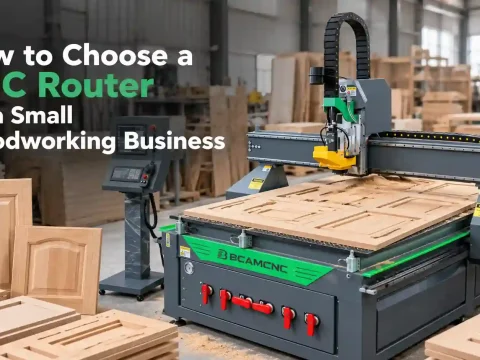

Starting or expanding a woodworking business often means finding ways to produce more parts without increasing manual work.
A CNC router can help small workshops cut cabinet panels, carve wooden doors, create signs and manufacture custom furniture components. However, choosing the wrong machine can lead to unnecessary expenses, limited production capacity or frequent manual adjustments.
The best CNC router for a small woodworking business is not necessarily the cheapest or most powerful machine. It is the one that matches your materials, products and daily workload.
Here are the key factors to consider before buying.
1. Start with the Products You Manufacture
Before comparing machine specifications, identify what your workshop produces most frequently.
Different woodworking applications require different machine configurations.
| Woodworking Application | Important CNC Router Features |
|---|---|
| Cabinet and furniture panels | Large working table, reliable sheet holding, accurate cutting |
| Wooden doors and decorative panels | Suitable spindle, carving capability, stable movement |
| Custom signs and wood engraving | Flexible tooling, appropriate working area |
| Solid wood furniture components | Suitable workholding, spindle and cutting tools |
| Repetitive furniture production | Automatic tool changing and efficient workflow |
For example, a workshop mainly cutting MDF cabinet panels may benefit more from a vacuum table than from additional spindle power.
A business producing decorative wooden doors may place greater importance on carving quality and tool flexibility.
Choose the machine around your products, not the other way around.
2. Choose the Right Working Table Size
Working area is one of the first specifications buyers compare.
Common industrial CNC router sizes include:
- 1300 × 2500 mm: Suitable for many standard sheet-processing applications.
- 1500 × 3000 mm: Provides additional space for larger panels and woodworking projects.
- 2000 × 3000 mm: Suitable for larger workpieces and workshops requiring greater processing capacity.
These dimensions are examples of common machine configurations. The best choice depends on your actual sheet sizes and available workshop space.
Remember that the machine’s overall dimensions are larger than its cutting area.
You also need room for material loading, unloading, maintenance and operator movement.
Buying a machine that is unnecessarily large increases floor-space requirements without necessarily improving productivity.
3. Understand Spindle Power and Cutting Requirements
Spindle power affects the types of cutting operations a CNC router can perform, but more power does not automatically mean better results.
For woodworking, spindle selection should consider:
- MDF, plywood, particle board or solid wood
- Material thickness
- Cutting depth and tool diameter
- Expected production volume
- Required surface finish
A properly configured spindle combined with suitable cutting tools can provide efficient machining for many woodworking applications.
For small businesses, the goal should be consistent cutting performance rather than choosing the highest available power rating.
4. Manual Tool Change or ATC CNC Router?
Tool changing is another important purchasing decision.
A basic three-axis CNC router with manual tool changing can be suitable for workshops performing relatively simple cutting or engraving operations.
However, some furniture components require multiple tools for cutting, drilling, grooving and decorative machining.
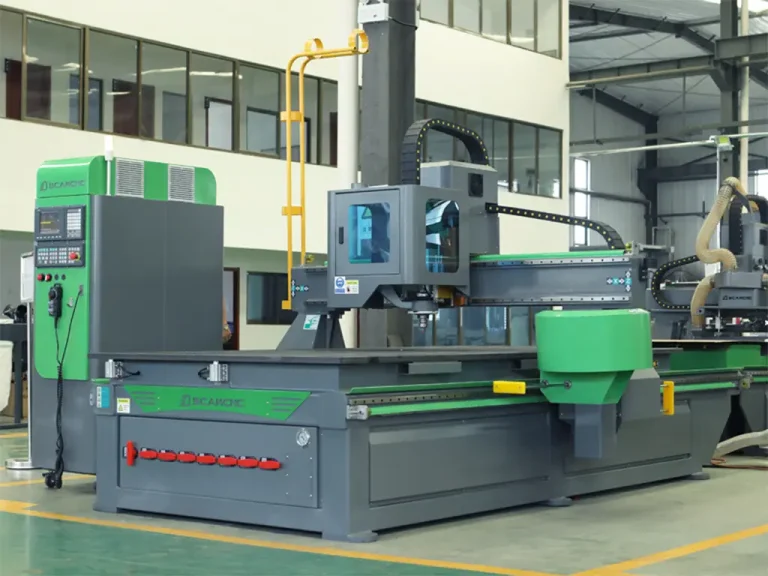
An ATC CNC router, or automatic tool changing CNC router, can switch between tools during a programmed machining process without requiring the operator to change each tool manually.
- Lower initial equipment cost
- Suitable for simpler machining tasks
- Requires operator involvement when changing tools
ATC CNC Router
- More convenient for multi-tool operations
- Reduces interruptions between machining steps
- Better suited to repetitive furniture production
If your workshop frequently processes different cabinet components, automatic tool changing may be worth the additional investment.
For simpler woodworking projects, a conventional three-axis CNC router may be sufficient.
5. Vacuum Table or T-Slot Table?
Workpiece holding directly affects cutting stability and daily operation.
A vacuum table is commonly used for holding flat MDF, plywood and other sheet materials.
It can simplify material positioning and reduce the need for mechanical clamps when sufficient vacuum holding force is available.
A T-slot table uses mechanical clamps to secure workpieces and can be useful for smaller, irregular or thicker materials.
Some woodworking CNC routers combine vacuum holding with T-slot clamping to provide greater flexibility.
For a workshop mainly producing cabinet panels, a vacuum table is often a practical choice.
For mixed woodworking applications, consider whether additional mechanical clamping options are necessary.
6. Consider Software and Operator Experience
A CNC router is only as useful as the workflow supporting it.
Before purchasing, check whether the machine’s controller and software are compatible with your design and production process.
Important questions include:
- Can your team prepare CNC programs using its existing software?
- Is the controller suitable for your operators?
- Can the supplier provide setup guidance and training?
- Are manuals and technical support available?
For small woodworking businesses, a straightforward operating process can be more valuable than advanced features that employees rarely use.
7. Compare Total Cost, Not Just Purchase Price
The initial machine price is only one part of the investment.
Other costs may include cutting tools, dust collection, electrical installation, shipping, training and routine maintenance.
A lower-priced machine may be attractive initially, but frequent downtime or inefficient operation can increase long-term expenses.
When comparing suppliers, consider machine construction, component quality, spare-parts availability and after-sales support.
A machine that matches your workload and operates consistently is usually a better investment than one selected solely for its lowest quotation.
Which CNC Router Is Right for Your Workshop?
For a small woodworking business, the right configuration depends on how the machine will be used.
| Workshop Type | Suggested Starting Point |
|---|---|
| Small engraving and custom woodworking shop | Standard 3 axis CNC router |
| MDF and plywood panel workshop | CNC router with suitable vacuum holding |
| Cabinet and furniture manufacturer | ATC CNC router for multi-tool operations |
| Mixed woodworking production | Flexible CNC router with appropriate tooling and workholding |
These are starting points rather than fixed rules. Actual material sizes, production requirements and budgets should determine the final configuration.
BCAMCNC CNC Router Solutions for Small Woodworking Businesses
BCAMCNC manufactures industrial CNC router machines for woodworking, furniture production, decorative carving and panel processing.
Depending on the application, customers can explore conventional three-axis CNC routers or configurations equipped with automatic tool changing and vacuum tables.
Rather than focusing on unnecessary features, BCAMCNC helps customers evaluate working dimensions, materials, tooling requirements and production needs before selecting a machine.
Whether you are opening a woodworking workshop or upgrading existing equipment, choosing a suitable configuration can help support more efficient daily production.
Frequently Asked Questions
Is a 3 axis CNC router enough for a small woodworking business?
Yes. A three-axis CNC router can handle many woodworking tasks, including cutting, engraving, grooving and shaping flat or relatively simple three-dimensional components.
Do small woodworking shops need an ATC CNC router?
Not always. ATC is most useful when production involves frequent tool changes. Workshops performing simpler operations may find manual tool changing sufficient.
Can one CNC router cut MDF, plywood and solid wood?
Yes, provided the machine has suitable cutting tools, workholding and machining parameters for each material.
What should I check before buying a CNC router from China?
Confirm the working area, spindle configuration, controller, table type, electrical requirements, shipping arrangements and available technical support.