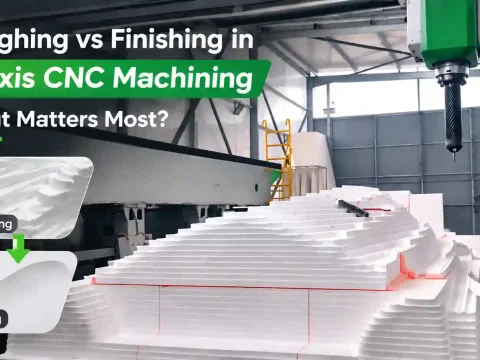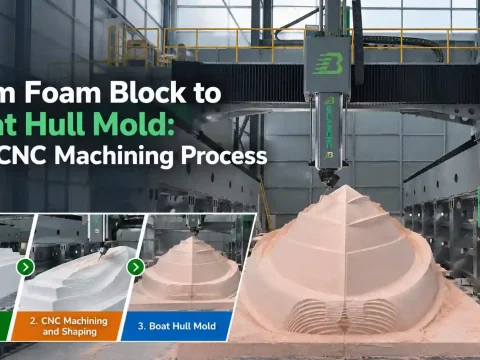

When machining a large foam mold, composite tooling pattern, or automotive model, removing material quickly is only part of the job. The finished surface must also match the intended shape and meet the requirements of the next production stage.
This is why roughing and finishing are two distinct but closely related stages in 5 axis CNC machining. Understanding their differences helps manufacturers balance machining time, surface quality, and overall production efficiency.
What Is Roughing in 5 Axis CNC Machining?
Roughing is the initial machining stage, where the CNC router removes most of the excess material from the workpiece.
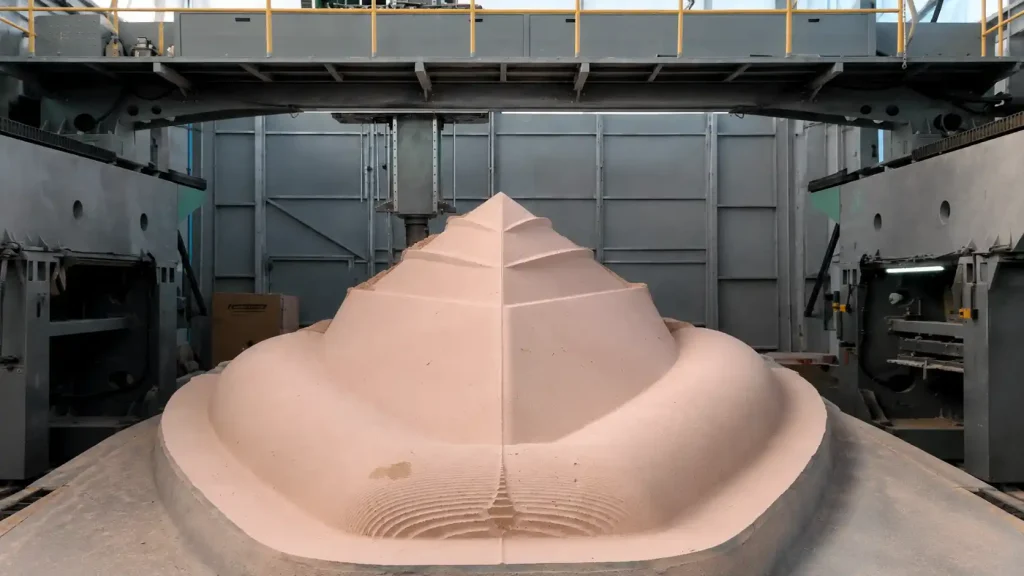
For large foam molds, such as boat hull patterns or industrial tooling models, roughing establishes the main shape before more detailed machining begins.
The primary goal is efficient material removal rather than achieving the final surface finish.
Several factors influence roughing performance:
Tool selection: Suitable cutting tools help remove material efficiently while maintaining stable cutting conditions.
Cutting parameters: Feed rate, spindle speed, and depth of cut must be matched to the material, tool, and machine configuration.
Machine rigidity: A stable machine structure helps manage cutting forces and maintain consistent machining performance.
For large workpieces, an effective roughing strategy can significantly reduce the amount of material that must be removed during finishing.
What Is Finishing in 5 Axis CNC Machining?
Finishing follows roughing and focuses on refining the workpiece surface to match the intended geometry.
Instead of removing large amounts of material, the finishing process typically uses smaller cutting increments and carefully planned toolpaths to improve surface consistency.
For complex molds, this stage is particularly important around curved surfaces, transitions, and areas where the cutting tool must approach the workpiece from different angles.
The final result depends on several factors:
Toolpath spacing: Smaller spacing between adjacent passes can reduce visible tool marks, although it may increase machining time.
Tool geometry: The cutter’s shape and size influence the surface it can produce and its ability to reach different areas.
Tool orientation: Five-axis movement allows the cutting tool to change its orientation, improving access to complex surfaces when the toolpath and machine configuration are appropriate.
Material properties: Foam, tooling board, and other materials respond differently to cutting, so machining strategies should be selected accordingly.
Finishing is not simply about making the machine move more slowly. It requires the right combination of tooling, toolpaths, and cutting conditions.
Roughing vs Finishing: What Is the Main Difference?
The two stages serve different purposes, and neither can fully replace the other in applications that require both efficient material removal and a refined surface.
| Factor | Roughing | Finishing |
|---|---|---|
| Main objective | Remove excess material | Refine the final geometry and surface |
| Material removal | Relatively high | Relatively low |
| Toolpath strategy | Focuses on efficient removal | Focuses on surface consistency and detail |
| Surface appearance | Often shows visible steps or tool marks | Usually smoother with less visible tool marking |
| Main consideration | Productivity and cutting stability | Surface quality and dimensional requirements |
The exact strategy depends on the material, part geometry, required finish, and production goals.
For some foam patterns, the surface may require additional sanding or coating. For other applications, machining requirements may be more demanding because the pattern will be used to produce a mold or composite component.
How Can You Balance Machining Time and Surface Quality?
A common mistake is to optimize roughing and finishing separately without considering the complete production process.
An aggressive roughing strategy may remove material quickly but leave an uneven allowance that makes finishing less predictable. Conversely, using very fine finishing passes everywhere can increase machining time without providing a meaningful improvement in the final product.
A more practical approach is to consider the entire machining sequence.
1. Leave a suitable finishing allowance
Roughing should leave enough material for finishing to remove remaining tool marks and refine the intended shape. The appropriate allowance depends on the material and machining strategy.
2. Match the tool to the application
Tool diameter, cutting geometry, and effective cutting length influence both material removal and surface quality. Deep or narrow features may require different tools from broad, accessible surfaces.
3. Optimize toolpaths for the actual geometry
Large, relatively simple surfaces may allow efficient toolpaths, while deep cavities and complex curves require greater attention to tool access and orientation.
4. Consider the machine’s capabilities
Mechanical rigidity, spindle performance, axis movement, and working space all affect which machining strategies can be used effectively.
5. Evaluate the result after machining
Surface inspection helps determine whether the finishing strategy meets the requirements or whether additional machining or manual post-processing is necessary.
The objective is not to minimize machining time at any cost. It is to achieve the required result with an efficient and repeatable process.
Why Does Five Axis Capability Matter for Large Mold Machining?
Large molds often contain curved surfaces, steep sections, and complex transitions that are difficult to access with a fixed vertical cutting direction.
A 5 axis CNC router can adjust the tool orientation while moving along the programmed toolpath. This provides greater flexibility when machining complex geometries and can reduce the need to reposition certain workpieces.
However, five-axis capability alone does not guarantee a better surface finish or shorter cycle time. Results still depend on programming, tool selection, machine configuration, and operator experience.
For large foam boat hull patterns, automotive models, and composite tooling, these factors should be evaluated together rather than relying on the number of axes alone.
Choosing the Right 5 Axis CNC Router for Your Project
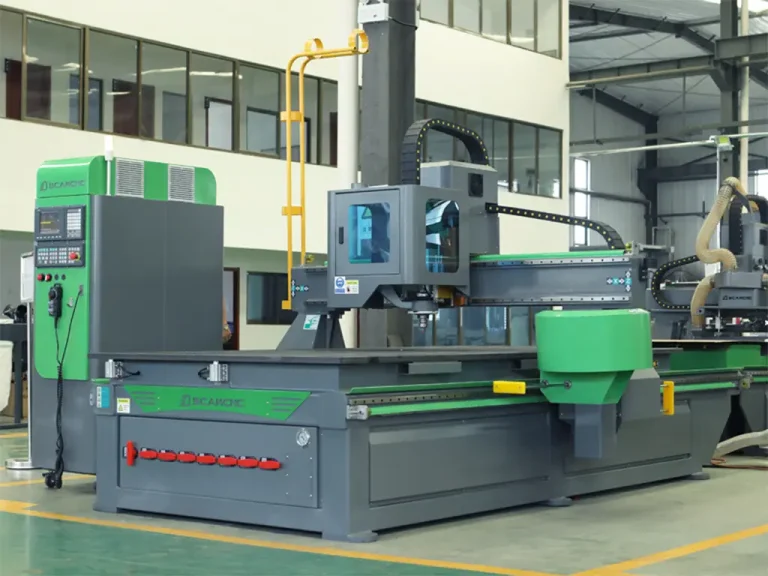
The most suitable machine depends on the material, workpiece dimensions, machining depth, surface requirements, and expected production volume.
BCAMCNC offers different five-axis CNC router configurations for applications ranging from general five-axis machining to large-format and deep machining projects.
For example, the BCAMCNC DL Series is positioned for large workpieces and deep machining requirements, while the D Series is intended for applications requiring a more rigid machining setup across a range of materials.
The appropriate configuration should be selected according to the actual project rather than the series name alone.
Before choosing a machine, manufacturers should consider the complete process: roughing efficiency, finishing requirements, tool accessibility, workpiece size, and any subsequent sanding or surface preparation.
Frequently Asked Questions
Does roughing or finishing take longer in 5 axis CNC machining?
It depends on the workpiece and machining strategy. Roughing removes more material, while finishing may require closely spaced toolpaths and careful control of surface quality. Either stage can become a significant part of the total cycle time.
Can a five-axis CNC router eliminate manual sanding?
Not in every application. Appropriate finishing strategies can reduce visible tool marks and manual work, but the required surface quality and subsequent manufacturing processes determine whether sanding is still necessary.
Does a smaller finishing step-over always produce a better surface?
Not necessarily. Smaller step-over can reduce visible scallops, but the final result also depends on cutter geometry, tool orientation, material properties, machine stability, and toolpath strategy.
Is five-axis machining always faster than three-axis machining?
No. Five-axis machining offers additional tool-orientation flexibility, particularly on complex surfaces. Whether it reduces total production time depends on the part geometry, programming, setup requirements, and machining strategy.
Final Thoughts
Roughing and finishing are complementary stages in successful mold production. Roughing focuses on removing excess material efficiently, while finishing refines the surface and geometry to meet the project’s requirements.
For large molds and complex three-dimensional patterns, the best results come from coordinating the two stages with suitable tooling, well-planned toolpaths, and a machine configured for the workpiece.
Planning a large foam mold, boat hull pattern, or composite tooling project? Contact BCAMCNC to discuss your material, workpiece dimensions, and five-axis machining requirements.