Choosing a 5-axis CNC router is not simply a matter of selecting the machine with the highest specifications. The right choice depends on what materials you process, the size and thickness of your workpieces, the applications you handle, and the production requirements of your business.
For businesses considering a 5-axis CNC router, a structured selection process can help avoid choosing a machine that is either under-equipped for the application or unnecessarily expensive for the actual workload.
BCAM CNC’s 5-axis product selection framework divides its machines into different series for different application requirements. The main series covered in this guide are the CE Series, D Series, DL Series, and F Series.
Start With Your Actual Processing Requirements
Before comparing machine models, it is important to define the work that the machine will actually perform.
What materials will you process?
The material is one of the first factors to consider. Different 5-axis CNC router configurations can be more suitable for different types of materials.
The selection framework covers applications involving materials such as:
- Wood
- Foam
- Plastics
- Acrylic
- Aluminum
- Composite materials
- Soft metals
- Various engineered materials
If your production involves primarily wood, foam, or plastic, the machine requirements may be different from applications involving aluminum, composite materials, or other harder materials.
What is the maximum workpiece size?
Workpiece dimensions should be determined before selecting the machine.
Consider:
- Maximum length
- Maximum width
- Maximum height
- Maximum material thickness
- Required machining range
- Whether oversized or deep workpieces need to be processed
A machine that is suitable for standard-size workpieces may not be appropriate for oversized parts or deep structures.
What is the final application?
The finished product is another important consideration.
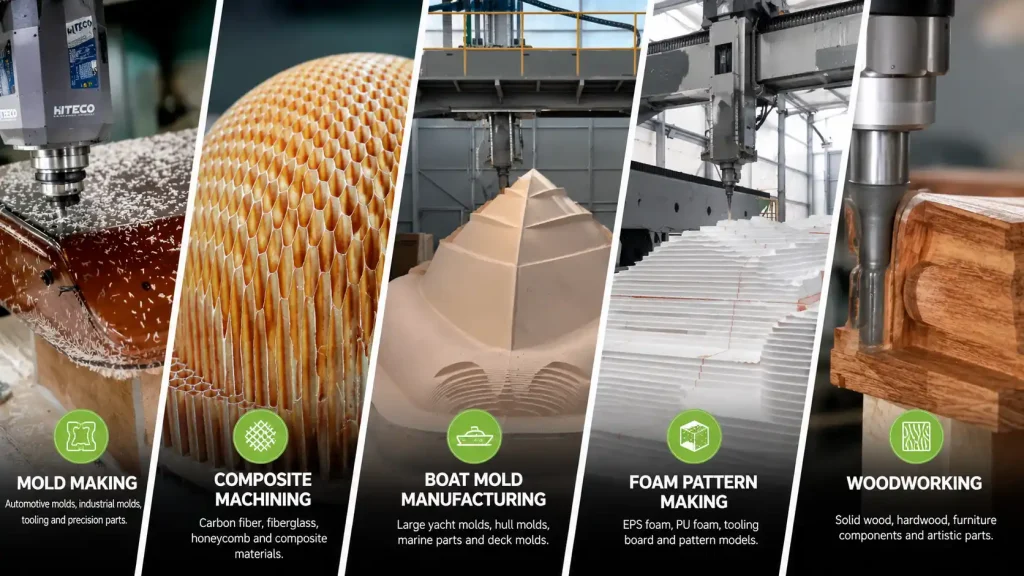
For example, 5-axis CNC routers can be used in applications involving:
- Mold and model making
- Automotive components
- Aerospace-related components
- Marine and yacht components
- Wind-energy components
- Furniture
- Large foam models
- Complex three-dimensional parts
The more clearly you define the final application, the easier it becomes to determine the appropriate machine series and configuration.
Understand the Main 5-Axis CNC Router Series
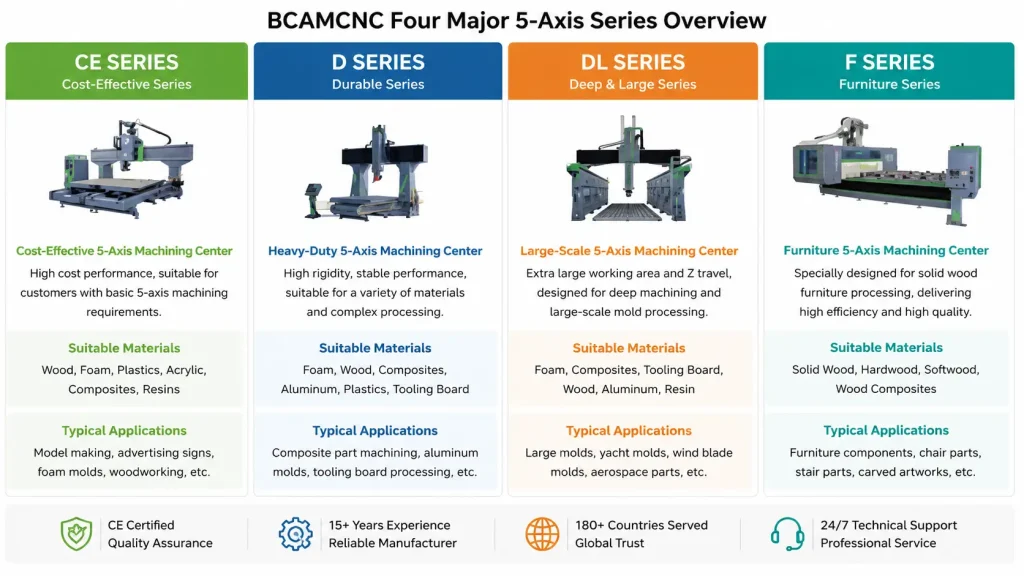
BCAM CNC’s selection framework organizes its 5-axis CNC routers into four main series for this guide: CE Series, D Series, DL Series, and F Series.
Each series is positioned for different combinations of material, workpiece size, and application requirements.
CE Series — Cost-Effective 5-Axis CNC Machining Center
The CE Series is described as an economical 5-axis machining solution designed for customers who need cost-effective processing.
According to the selection framework, it is mainly intended for general processing of materials such as wood, foam, plastic, acrylic, and composite materials.
Typical applications include:
- Model making
- Advertising products
- Foam models
- Woodworking
- General 3D machining
For businesses looking for a practical entry point into 5-axis CNC machining and whose applications do not require particularly large workpieces or heavy-duty machining, the CE Series can be considered as one potential option.
D Series — Durable 5-Axis CNC Machining Center
The D Series is positioned as a durable 5-axis machining solution with an emphasis on structural strength and stability.
The selection chart lists applications involving aluminum, wood, foam, composite materials, and soft metals.
Typical applications include:
- Mold machining
- Aluminum processing
- Composite material processing
- High-precision component machining
This type of machine may be worth considering when the production process places greater emphasis on structural rigidity and machining requirements.
DL Series — Deep & Large 5-Axis CNC Machining Center
The DL Series is designed around large and deep machining requirements.
The selection framework identifies features including a longer machining range and a large Z-axis machining range, with applications focused on large-scale model and deep-structure machining.
Typical materials listed include:
- Foam
- Wood
- Composite materials
- Aluminum
- Resin
- Soft metals
Typical applications include:
- Ship models
- Large molds
- Large foam models
- Aerospace-related models
- Large-scale model production
If your business regularly works with oversized workpieces or requires greater machining depth, the DL Series should be evaluated based on the actual dimensions of your workpieces.
F Series — Furniture 5-Axis CNC Machining Center
The F Series is positioned specifically for solid-wood furniture and irregular-shaped furniture components.
The selection framework lists materials such as:
- Solid wood
- Pine
- Hardwood
- Birch
- Oak
- Other wood materials
Typical applications include:
- Chair legs
- Chair components
- Table components
- Sofa components
- Irregular-shaped furniture parts
For furniture manufacturers working with complex solid-wood components, a furniture-focused 5-axis CNC configuration can be evaluated according to the required part geometry and machining process.
Match the Machine to Your Workpiece Size
Workpiece size is one of the clearest factors for narrowing down your options.
The selection framework provides a simple decision path based on whether the material is relatively soft or hard, followed by the required workpiece dimensions.
Standard-size workpieces
For standard-size workpieces, the D Series is one of the options identified in the selection framework, particularly for applications involving materials such as aluminum, wood, foam, and composite materials.
Oversized workpieces
For oversized workpieces, the selection framework directs attention toward the DL Series when greater machining dimensions or depth are required.
This is particularly relevant to industries such as large-scale model making, shipbuilding-related model production, aerospace-related models, and other applications involving large components.
Furniture components
When the primary requirement is machining solid-wood furniture components with irregular shapes, the F Series is identified as the furniture-oriented option.
Consider the Spindle and Tool Changer Configuration
Once the machine series has been narrowed down, the next step is to evaluate the machine configuration.
Spindle power
The appropriate spindle power should be selected according to the material and machining requirements.
The BCAM CNC selection framework lists spindle power options including 9 kW, 13.5 kW, and 18 kW. The appropriate option should be determined according to the intended processing conditions rather than simply selecting the highest available power.
Tool changer
Tool-changing requirements can have a direct impact on production efficiency.
The configuration framework lists 8-tool, 12-tool, and 16-tool tool changer options.
A larger tool capacity may be worth considering when a machining process requires multiple tools and frequent tool changes.
Vacuum table, T-slot table, or fixture
The workholding method should also match the application.
Depending on the workpiece and machining process, the configuration framework identifies options including:
- T-slot table
- Vacuum table
- Fixture-based workholding
The best choice depends on the shape, material, dimensions, and machining requirements of the workpiece.
Control system
The control system is another important part of a 5-axis CNC router configuration.
The selection framework identifies 5-axis simultaneous control with RTCP as part of the configuration considerations. For complex surfaces and multi-axis machining, the control system should be evaluated together with the machine’s mechanical configuration and the intended application.
Dust extraction
For applications involving materials such as wood, foam, and other materials that generate machining debris, an appropriate dust extraction solution should be considered as part of the overall machine configuration.
Ask These Seven Questions Before Requesting a Quote
A detailed quotation starts with accurate application information.
Before contacting a CNC manufacturer, prepare answers to these seven questions:
1. What material do you mainly process?
Identify the primary material and any secondary materials that may also need to be machined.
2. What is the maximum workpiece size?
Provide the maximum length, width, and height whenever possible.
3. What is the maximum required height or thickness?
This information is particularly important for deep machining applications.
4. What is the final product or application?
Explain what you are manufacturing rather than only describing the material.
5. Do you require five-axis simultaneous machining?
Not every application has the same multi-axis machining requirements. Clarify whether simultaneous 5-axis machining is necessary for your parts.
6. Do you require automatic tool changing?
If multiple tools are used during production, an automatic tool changer may be an important part of the configuration.
7. Where will the machine be installed?
The destination country or region should be provided when requesting a quotation so that the manufacturer can consider the relevant delivery and service requirements.
Why Machine Selection Should Start With the Application
A common mistake when purchasing a CNC machine is to begin with machine specifications and only later consider the actual application.
A better approach is to work in the opposite direction:
Application → Material → Workpiece Size → Machining Requirements → Machine Series → Configuration
For example, a business producing large foam models may have very different requirements from a furniture manufacturer producing complex solid-wood components. Similarly, aluminum machining may require different considerations from general wood or foam processing.
This application-first approach makes it easier to compare machines based on practical requirements rather than isolated specifications.
Build the Configuration Around Your Production Needs
There is no single 5-axis CNC router configuration that is automatically suitable for every business.
A suitable configuration should take into account:
Material
Determine the materials that will actually be processed.
Workpiece dimensions
Define the maximum size and machining depth required.
Application
Identify whether the machine will mainly be used for molds, models, furniture, automotive-related components, aerospace-related models, marine-related components, or other products.
Production volume
Consider how frequently the machine will operate and whether automatic tool changing or other productivity-oriented configurations are required.
Machining complexity
For complex three-dimensional surfaces, evaluate the complete 5-axis system, including the machine structure, rotary/tilting axis configuration, control system, and RTCP capabilities.
Budget
A higher specification is not necessarily a better choice if those specifications are not required for your actual production.
How BCAM CNC Approaches 5-Axis Machine Selection
BCAM CNC’s 5-axis selection framework follows a customer-oriented process:
Customer inquiry → Requirement confirmation → Series selection → Configuration recommendation → Solution quotation → Follow-up communication → Production and service
The objective is to first understand the customer’s requirements and then select a suitable machine series and configuration.
For customers who are unsure which 5-axis CNC router is appropriate, providing detailed information about the material, workpiece dimensions, application, machining requirements, automatic tool-changing requirements, and destination can help make the machine selection process more targeted.
Final Thoughts
Choosing the right 5-axis CNC router should begin with your application—not the machine specification sheet.
For general and cost-conscious applications, the CE Series may be worth evaluating. For applications requiring a durable configuration and processing of materials such as aluminum and composites, the D Series can be considered. For large and deep workpieces, the DL Series provides another option to evaluate. For solid-wood and irregular-shaped furniture components, the F Series is positioned specifically around furniture applications.
The most suitable machine ultimately depends on your actual material, workpiece size, application, machining requirements, and desired configuration.
If you are comparing 5-axis CNC routers for your business, providing these details to the manufacturer is the best starting point for developing a suitable machine solution.