Choosing the wrong assist gas in fiber laser cutting does more than change the appearance of the cut edge. It can slow production, increase dross, create extra grinding before welding or coating, and quietly raise the cost of every finished part.
In practical production, oxygen is commonly used for carbon steel where the oxidation reaction assists cutting; nitrogen is preferred when a clean, low-oxidation edge is important; compressed air can reduce gas costs for suitable materials and quality requirements.
There is no single best assist gas.
The right choice depends on the material, thickness, laser power, required edge quality, gas supply and — something buyers often overlook — what happens to the part after laser cutting.
Why Does a Fiber Laser Cutting Machine Need Assist Gas?
During fiber laser cutting, the laser beam heats and melts the material along the cutting path. Assist gas passes through the nozzle and helps remove molten material from the kerf.
But removing molten metal is only part of its job.
Assist gas also influences:
- Cutting reaction
- Edge oxidation
- Dross formation
- Cut surface appearance
- Process stability
- Downstream processing
- Operating cost
This is why changing from oxygen to nitrogen is not simply a matter of switching the gas supply.
Cutting speed, gas pressure, nozzle selection, focus position and other process parameters may also need to be adjusted.
Oxygen: A Practical Choice for Carbon Steel
Oxygen is widely used when fiber laser cutting carbon steel and mild steel.
When oxygen reaches the heated steel, an exothermic oxidation reaction occurs. This reaction contributes additional heat to the cutting process and can be particularly useful in carbon-steel applications.
Where oxygen makes sense
Oxygen is commonly considered for:
- Carbon steel
- Mild steel plate
- Structural components
- Applications where an oxidized edge is acceptable
- Jobs where cutting capability is more important than a bright metallic edge
However, oxygen creates an oxide layer on the cut surface.
This is where production planning becomes important.
If the part goes directly to assembly and the oxide layer is acceptable, this may not create a problem. But if the edge needs welding, painting, powder coating or another finishing process, additional surface preparation may be required depending on the specification.
That secondary operation costs labor and time.
A faster laser cut does not automatically mean a lower-cost finished part.
What operators should watch
More oxygen pressure does not automatically improve cutting.
Gas purity, nozzle condition, focus position, laser power, material condition and cutting speed all influence the result.
Incorrect parameters can lead to excessive burning, rough edges or increased dross.
Nitrogen: When Edge Quality Matters
Nitrogen works differently from oxygen.
It is used primarily to expel molten material while limiting oxidation at the cut edge.
The result can be a cleaner metallic edge, which is why nitrogen is commonly selected for:
- Stainless steel
- Aluminum and aluminum alloys
- Visible components
- Parts requiring cleaner edges
- Applications where downstream processing benefits from reduced oxidation
For stainless-steel fabrication in particular, edge appearance can be an important production requirement.
But nitrogen introduces another consideration:
gas consumption.
High-pressure nitrogen cutting can require substantial gas flow depending on material thickness, nozzle configuration and cutting parameters.
For a factory running one or two shifts every day, nitrogen is therefore not just a consumable. It can become a significant part of operating cost.
This is why evaluating a fiber laser cutting machine based only on electrical consumption gives an incomplete picture.
Compressed Air: Lower Gas Cost, but Not Free Cutting
Compressed air is attractive because it can be generated on site rather than continuously purchasing oxygen or nitrogen.
Atmospheric air contains mostly nitrogen together with oxygen and other gases. For suitable applications, properly prepared compressed air can therefore be used as an assist gas.
Depending on the machine configuration, material and quality requirements, compressed air may be considered for certain cutting applications involving:
- Carbon steel
- Stainless steel
- Aluminum
Its biggest attraction is operating cost.
But there is a common misunderstanding:
Compressed air is not free nitrogen.
A reliable laser cutting air supply may require:
- Suitable compressor capacity
- Stable pressure
- Air storage
- Drying equipment
- Effective filtration
- Oil and moisture control
Poor-quality compressed air can affect cutting consistency and may introduce contamination into the gas delivery system.
The real cost calculation should therefore include:
compressor investment + electricity + dryer + filters + maintenance
—not simply the cost of atmospheric air.
Oxygen vs Nitrogen vs Compressed Air: Quick Comparison
| Factor | Oxygen | Nitrogen | Compressed Air |
|---|---|---|---|
| Typical application | Carbon steel | Stainless steel, aluminum, clean-edge work | Cost-sensitive general cutting where suitable |
| Cutting principle | Supports oxidation reaction | Expels molten material while limiting oxidation | Mixed-gas cutting |
| Edge oxidation | Higher | Low when correctly controlled | Depends on material and process |
| Edge appearance | Typically oxidized | Cleaner metallic edge | Application-dependent |
| Gas cost consideration | Usually manageable but supply-dependent | Can become significant in continuous production | Potentially lower after air-system investment |
| System requirement | Suitable oxygen supply | Suitable nitrogen supply | Compressor, dryer and filtration |
| Main reason to choose | Carbon-steel cutting performance | Edge quality | Operating-cost optimization |
This table is a general selection guide rather than a cutting-parameter chart. Actual results depend on laser power, material grade, thickness, cutting head, nozzle, gas quality and machine configuration.
Material Thickness Changes the Gas Decision
A customer may ask:
“Which gas should I use for 10 mm metal?”
An experienced engineer should ask another question first:
What metal?
Ten-millimeter carbon steel, stainless steel and aluminum are three different cutting problems.
Thickness alone is not enough.
Before choosing the assist gas, consider:
- Material type and grade
- Material thickness
- Available laser power
- Required edge quality
- Production volume
- Downstream process
- Local gas availability and price
Laser power matters as well.
The practical cutting strategy for the same material can change significantly between different laser power levels.
This is one reason generic online cutting charts should be treated carefully. They may provide a reference, but they should not replace parameters tested for the actual machine, material and cutting conditions.
The Hidden Cost Is Often After Laser Cutting
This is one of the most important considerations when choosing assist gas.
Imagine two production routes.
Process A
The machine cuts the component efficiently with oxygen, but the oxidized edge needs additional treatment before the next operation.
Process B
Nitrogen costs more during cutting but produces an edge that can move more directly to the following process.
Which process is cheaper?
Cutting speed alone cannot answer that question.
A more realistic calculation is:
Total Part Cost = Cutting Time + Gas + Electricity + Consumables + Labor + Secondary Processing + Scrap
This matters particularly in factories where laser cutting feeds directly into:
- Press brake bending
- Welding
- Grinding
- Powder coating
- Painting
- Automated sheet-metal production
Optimizing only the laser cutting operation can simply move cost from one workstation to another.
For a factory manager, cost per finished part matters more than cost per cutting minute.
Why Gas Supply Should Be Considered Before Buying the Machine
Assist gas is sometimes discussed only after the fiber laser cutting machine has already been selected.
That is too late.
A factory should investigate local gas supply during the equipment-selection stage.
Questions worth asking include:
Is bulk nitrogen readily available?
A factory with reliable industrial gas supply may make different decisions from a plant located far from gas suppliers.
What does nitrogen cost locally?
Gas economics vary significantly by country and region.
Can the existing compressor system support laser cutting?
A general workshop compressor should not automatically be assumed suitable for laser cutting.
How many hours will the laser operate every day?
Gas economics change considerably between occasional production and continuous multi-shift cutting.
These factors can influence the best machine and auxiliary-equipment configuration.
What About Hydrogen?
Hydrogen should not normally be treated as a direct alternative to oxygen, nitrogen and compressed air for standard fiber laser sheet cutting.
Pure hydrogen is not a general-purpose assist gas for conventional fiber laser sheet-metal cutting, and its flammability introduces additional safety considerations.
Specialized industrial processes may use particular gas mixtures containing hydrogen, but these require application-specific engineering and appropriate safety systems.
For most manufacturers purchasing a standard fiber laser cutting machine, the practical decision is:
Oxygen vs Nitrogen vs Compressed Air.
Hydrogen should not be introduced simply because it appears in a generic discussion about industrial cutting gases.
How to Choose the Right Assist Gas
Instead of starting with the gas, start with the finished component.
1. What material represents most of your production?
Carbon steel, stainless steel and aluminum behave differently during laser cutting.
2. What thickness range do you cut every day?
Do not configure the entire production system around an unusual maximum-thickness job that represents only a small percentage of annual production.
3. What edge quality does the next process require?
A decorative stainless-steel component has different requirements from a structural carbon-steel bracket.
4. What happens immediately after cutting?
If the part goes to bending, welding or coating, evaluate how the cutting method affects that process.
5. What does each gas actually cost at your factory?
Compare local oxygen and nitrogen supply with the full cost of installing and operating a suitable compressed-air system.
The objective is not to find the cheapest gas.
It is to find the lowest practical manufacturing cost while maintaining the required part quality.
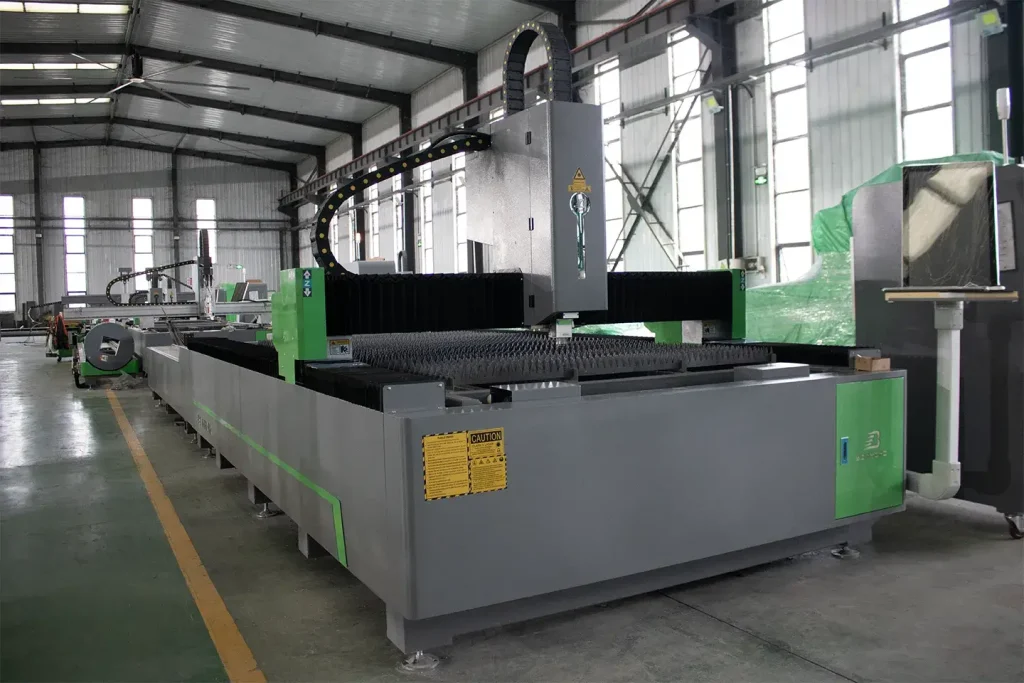
Choosing a Fiber Laser Cutting Solution with BCAMCNC
Laser power is only one part of selecting a fiber laser cutting machine.
Material mix, thickness range, edge-quality requirements, assist-gas strategy and downstream processes should be considered together.
A factory cutting mainly carbon steel may require a different production strategy from a manufacturer processing stainless-steel cabinets or aluminum components.
BCAMCNC works with customers to evaluate fiber laser cutting configurations according to actual production requirements rather than focusing only on maximum laser power or maximum cutting thickness.
If you are evaluating a fiber laser cutting machine, provide the technical team with:
- Material types
- Common thickness range
- Maximum required thickness
- Typical part drawings
- Required edge quality
- Expected daily production volume
- Available gas supply
These details make it possible to discuss not only whether the machine can cut the material, but also how the complete cutting process should be configured for practical production.
Frequently Asked Questions
Is nitrogen better than oxygen for fiber laser cutting?
No. Nitrogen and oxygen serve different production requirements. Nitrogen is commonly selected when minimizing oxidation is important, while oxygen is widely used for carbon-steel cutting where the oxidation reaction assists the process.
Which assist gas should I use for carbon steel?
Oxygen is commonly used for carbon steel. Nitrogen or compressed air may also be considered for certain applications depending on thickness, laser power and required edge condition.
Which assist gas should I use for stainless steel?
Nitrogen is commonly selected when a clean, low-oxidation stainless-steel edge is required. Compressed air may be practical for some applications where the resulting edge quality meets production requirements.
Can compressed air replace nitrogen?
For some materials, thickness ranges and quality requirements, yes. But compressed air is not a universal replacement for nitrogen. Air quality, pressure, compressor capacity and filtration must also be considered.
Why can nitrogen cutting become expensive?
Nitrogen consumption depends on factors such as pressure, nozzle size, material thickness and cutting conditions. In continuous production, gas supply can become a significant operating expense.
Should assist gas be considered before buying a fiber laser cutting machine?
Yes. Material mix, local gas availability, production volume and downstream requirements can all influence the most economical machine and auxiliary-system configuration.